Pressure that fades over months is another matter. Here we deal with the morning the shower went limp and nothing else had changed. A weak single fixture points at its own aerator, cartridge or supply valve. Every tap weak points at the main valve, the regulator, a leak or the supply itself. This sits under low water pressure and keeps to a plumber's testing order.
Is the weakness in one spot or everywhere?
Open taps in several places, hot and cold: kitchen, bathroom, laundry, one outdoors. Weakness at a single fixture, or hot water only, is local, a gummed-up aerator, a tired cartridge, a half-shut supply valve or a heater fault. Weakness everywhere implicates the main line, regulator or supply. Jot down what you find.
Weak hot only? Suspect the water heater or its shutoff. Weak cold only? Look at the cold supply. Unscrew the aerator at the spout and rinse out the grit, since debris from plumbing work or a utility event tends to land there first. Timing is a clue too: a drop right after a repair or a shutoff points to a valve left partly shut.
Is the problem on the city side or in the neighborhood?
Ask next door. A whole street with weak water usually means a main break, hydrant use, valve operation or utility maintenance. The Ontario Municipal Utilities Company runs the public water system and can be reached at (909) 395-2600 about low pressure or work nearby.
Neighbors fine and you not? The trouble is on your property, from the meter onward. The utility can also say if a shutoff happened recently. Debris can enter the pipes after utility work, so after any shutoff, run each tap for a minute to flush it through. Problems that persist need a plumber.
Has the pressure regulator failed?
Many houses carry a pressure regulator, a bell-shaped valve near the water entry. A failed one can starve the house or surge it. Section 608.2 of the California Plumbing Code sets 80 psi as the static cap, and the regulator keeps the house under it. A gauge threaded onto an outdoor tap gives the reading.
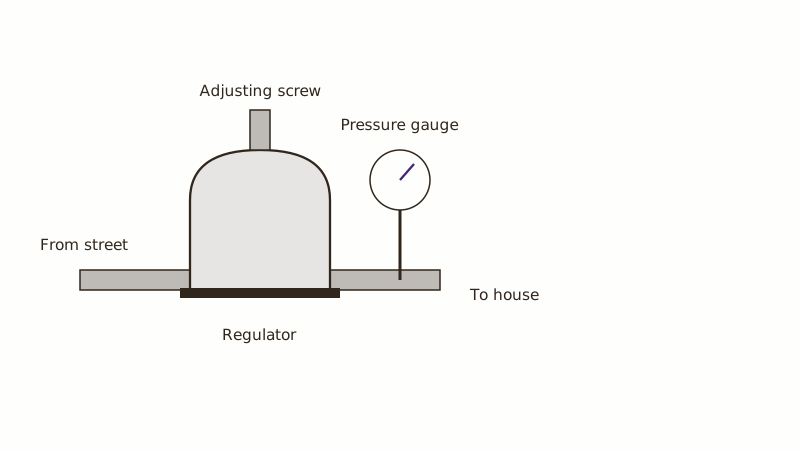
A low reading with the main open and no leak suggests a regulator that is stuck, clogged or worn. Leave adjustments alone unless you know what you are doing; its location is explained in where a water pressure regulator is located, and swapping one in replacing a regulator. A plumber can gauge-test it and replace it, often a short visit.
What else can cut the pressure suddenly?
Other suspects: a clogged whole-house filter cartridge, a softener stuck mid-regeneration, a half-closed appliance valve, sediment in old galvanized supply pipe, or a failing water heater. Older galvanized pipe restricts flow as it corrodes, though that normally builds slowly rather than overnight.
Look at the filter and softener first because they take a minute: put the softener in bypass and see if pressure returns, and swap a dirty filter cartridge. Corrosion and hard-water scale are slower culprits, listed in why my water pressure is low. If nothing explains it, call a plumber.
Call when there is no pressure at all, a leak you cannot find, a stuck or leaking valve, a failed regulator, or anything touching the water heater's gas or electrical parts. State rules reserve work of $1,000 or more, or permitted work, for a contractor with a California license. To arrange it, ask for quotes; the figure comes in writing first. More services are on the home page.
Could a leak be draining the pressure?
Yes. A break in the house, the yard line or the service line lets water out before it reaches the taps. Shut every tap and study the meter; a dial or small triangle still turning means a leak somewhere. Look for damp spots, soggy lawn, running-water sounds or a jump in the bill.
EPA's average-household leak figure is above 9,300 gallons a year, and a real break does far more. When the meter still moves, close the main and watch again: movement that stops means the leak is on your side of the valve, and movement that continues suggests the utility side. A high bill with no visible leak explains the check in depth.
Was a valve left half-open after recent work?
It is a frequent sudden cause and the cheapest cure. After a repair, a new appliance or a utility shutoff, the main or meter valve may never have been opened fully. Find the main shutoff where the pipe enters the house, plus the one at the meter, and confirm both are wide open.
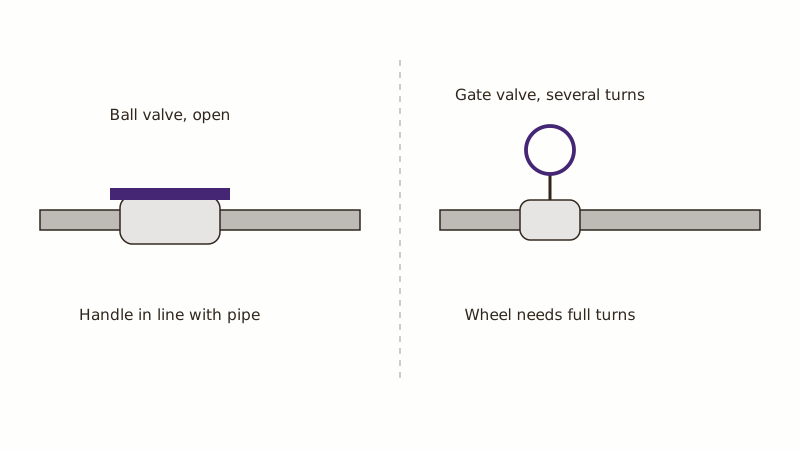
Valve types differ. A ball valve is fully open with its handle in line with the pipe; a gate valve needs several full turns. Old stiff valves may refuse to open completely, and forcing one can snap it. A stuck valve, or one weeping at the stem, is a plumber's job. Do not forget the shutoffs at the water heater, softener and filter.
Common questions
Does weak pressure harm anything?
Mostly it is an annoyance, yet a sudden drop can signal a leak soaking walls or floors, and swings up and down can stress appliances. Low flow can also make a tankless unit shut down or cycle. A sudden drop with no explanation is a reason to hunt for a leak.
Does pressure normally sag at busy hours?
It can, when many households draw water together, such as on a busy morning, but a sudden drop that stays is not normal. If it happens only at peak hours, tell the utility. If it changed overnight and stays low, work through the checks above.
Could the meter itself be at fault?
Possibly, if its strainer is clogged or the valve there is partly shut. The meter belongs to the utility, so do not open it; call the Ontario Municipal Utilities Company at (909) 395-2600. A plumber can tell whether the trouble sits before or after the meter.
What is the way to read my own pressure?
Thread a gauge onto an outside spigot, open it and read the dial while the rest stay closed. Hardware stores sell gauges. Above 80 psi is over the code limit and needs a regulator; a reading far below your old normal points to one of the causes above.
Why only the shower?
A clogged head, a worn cartridge or a mixing valve can choke one fixture while the rest of the house runs fine. Take the showerhead off and soak it, or check the cartridge. More causes are in shower water pressure is low.