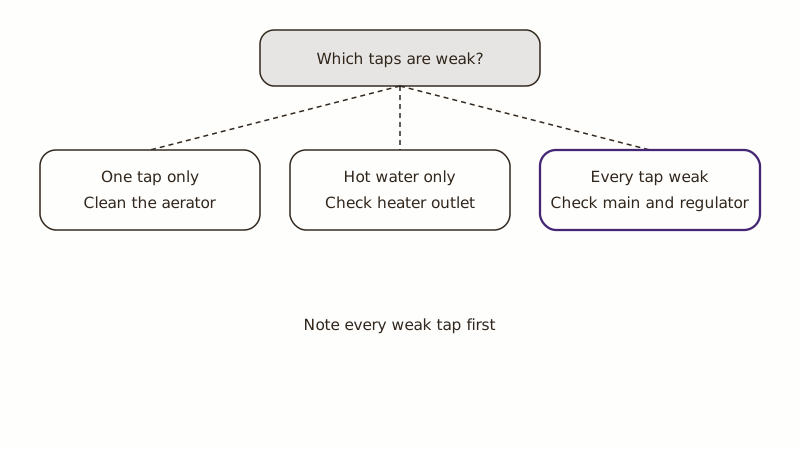
Is it one faucet, one floor, or the entire house?
Count the affected outlets before touching a tool. If just one spout is weak, suspect its own screen or cartridge. Only hot sagging? The heater is your next stop. If everything is weak, the trouble sits upstream: street, main valve, regulator, or a leak. The pattern narrows the search in about a minute.
That triage is the reason this page is organized by symptom. For a broader look at fixes and what a visit involves, the low-pressure repair page handles the fixing, while this page is about diagnosis.
Try each tap, upstairs and down, plus the hose bib and the washing machine valve. Write down which ones are weak. That note is worth a lot to whoever comes out later.
Why is the flow weak at just one tap?
One lone weak spout is nearly always a gritty aerator, a showerhead furred with lime, or a worn cartridge; nothing wrong elsewhere. Spin the aerator off, shake out the debris, and let it sit in vinegar if scale is visible. Flow frequently snaps back within minutes.
Local water is hard enough for this to be a routine chore. Ontario's 2025 report puts source-by-source hardness averages between 91 and 177 ppm, and Monte Vista Water District, Montclair's supplier, published a 135 ppm average for 2025. Scale narrows holes in aerators and shower plates. Seeing crust? Follow up with scale removal tips.
If cleaning does nothing, check the little stop valves under the sink: a half-closed angle stop starves one faucet and nothing else.
Hot water trickles but cold is fine. Why?
Strong cold and feeble hot shifts attention to the heater and its connections. A partly closed shutoff on the heater outlet, sediment choking the tank outlet, or corroded galvanized hot lines are typical causes. Mixed-up shower valves can also fake it.
Prove it by running hot, then cold, from one sink. If cold is fine and hot trickles, the supply side is healthy and the problem lies downstream of the heater. Galvanized steel silts up from within, and hot lines often clog first. The page on hot water pressure problems goes deeper into that branch.
What drags pressure down across the entire house?
When everything is weak, suspect something shared: a main valve opened only partway, an aging regulator, a clogged strainer, rusted supply pipe, a concealed leak, or less pressure arriving from the utility. Since every fixture suffers together, begin at the meter and move inward.
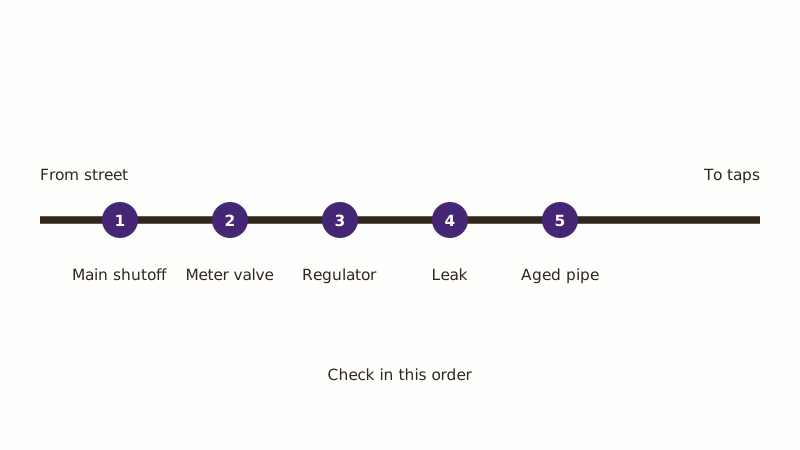
Check in this sequence:
- The main shutoff. Make sure the handle is fully open, or the valve inside is not half-seated after a recent repair.
- The meter valve. Do not touch the utility side. If you suspect a problem at the meter box, report it to your water provider.
- The regulator. Many homes have a bell-shaped pressure reducing valve near the main. If it has failed, you can see weak flow or, on the flip side, dangerously high pressure.
- A leak. A line that leaks en route starves the taps. Close every fixture and see if the meter dial keeps moving.
- Aged pipe. Rust narrows galvanized steel, and deposits can narrow copper.
If a neighbor has the same issue, call the water provider. Pressure is a utility matter up to the meter.
Why do water pressure regulators fail?
Regulators have a spring and a rubber diaphragm that wear out, and grit or mineral scale can jam the seat. Most last for years, but when they go they either let pressure creep up or choke flow. A regulator gone bad explains many houses that suddenly feel feeble or, oddly, forceful.
Signs include water hammer, a hissing at fixtures, a toilet that fills slowly, and a pressure gauge that does not match what you feel. Static pressure shows on a hose-bib gauge. Under section 608.2 of the plumbing code, 80 psi is the ceiling in California, and most homes manage that with a regulator. Tweaking one is described in adjusting a regulator valve; replacement or anything that opens the main belongs to a contractor.
Could my neighborhood or the hills be the reason?
Sometimes. Elevation and pressure zones affect what reaches your tap. Hillside homes can sit in separate pressure zones, and Chino Hills' housing element flags low water pressure in Los Serranos and Sleepy Hollow, the older parts of Carbon Canyon. Ask your supplier about your own zone, since we have no verified pressure data for flat areas.
Ontario's water comes from a mix of groundwater and imported supply managed by the City's utilities company, while Chino Hills buys from several sources and Montclair's retail water comes from Monte Vista Water District. Pressure details depend on your zone, so ask your own provider whether work in the area is planned or whether they can check pressure at your meter. The Chino Hills page describes the terrain in more detail.
Is weak pressure a safety issue?
It is rarely an emergency, but it can signal trouble. A sudden drop may mean a major leak or a broken main, which wastes water and can damage property. A dribbling shower valve can also swing from lukewarm to hot when pressure surges back, so keep the temperature knob in mind.
The bigger risks are the ones that hide: a slow leak running under the slab, sediment plugging a heater, or a regulator that is about to fail high. Abrupt drop plus a meter that spins with all taps shut: close the main valve, then reach a plumber. If water reaches outlets or wiring, switch power off at the breaker panel, never from a wet floor.
Who can diagnose it for me?
Use the phone or the form to share the weak-pressure pattern, the house's age, and any neighbors with the same trouble. A local plumber gets arranged. We answer weekdays 9am to 5pm. Once a contractor quotes, look the license up with the state contractor board.
Get the cause and the fix named on a written quote. Phone talk is guesswork; the paper issued after an inspection sets the number. Head for the quote page, or browse more from the Chaffey Pipe and Drain home page.
Common questions
Could low pressure be caused by my pipes being old?
Yes. Galvanized steel corrodes inside and narrows, and copper can scale up over decades, so flow drops at every fixture. Older houses near downtown Ontario and Euclid Avenue are the likeliest to have this. A professional can measure flow and inspect the pipe. If the lines are failing, repiping may be the lasting fix.
How do I measure water pressure at home?
Buy an inexpensive gauge with a hose-bib thread at a hardware store, thread it on a hose faucet outdoors, and turn the tap fully on with everything else off. Many homes sit around 50 to 60 psi. Readings above 80 psi break the plumbing code limit, and a very low number points to a supply or regulator problem.
Does a water softener lower pressure?
It can, if the resin bed is clogged or the valve is set badly, or if the unit was undersized. A bypass valve lets you test with the softener out of the loop. If pressure recovers, the softener is the cause. Ask the installer to check flow ratings against your household demand.
Does a booster pump solve weak pressure?
Only if the supply is adequate and the pipe can carry more flow. A booster helps with a long run or a house high on a hill, but it cannot fix a clogged line or a half-closed valve, and it raises stress on old pipe. Diagnose first, then decide.
Can a plumber fix this in one visit?
Often yes for aerators, regulators and valves. A hidden leak or corroded main line needs more time, and utility-side issues are not the plumber's to fix. Expect a diagnosis and a written quote first, then a schedule for the repair.