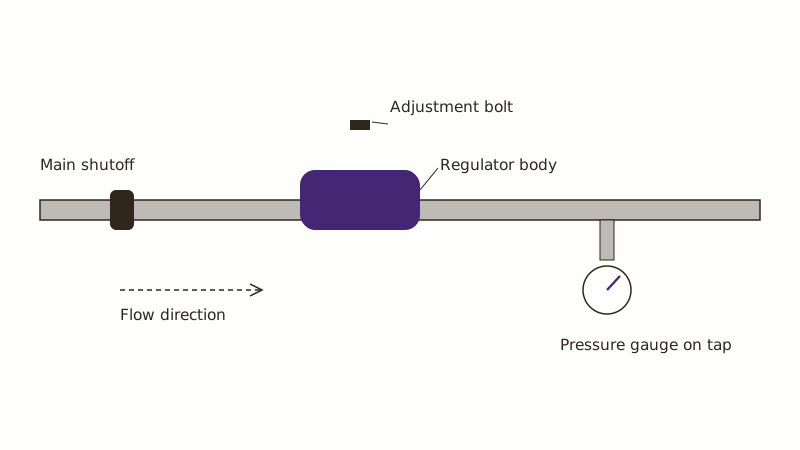
Every house on municipal water has pressure that the utility sets for the street, not for your fixtures. A regulator steps it down. Once it tires, pressure may creep upward, sag, or swing through the day, and your fixtures, hoses and water heater absorb the abuse. On paper the swap is quick, but it involves cutting into the supply pipe and dialing in the setting afterward. This guide belongs to low water pressure, and a quote request arranges a local plumber if you want the work done for you.
How do you know the regulator needs replacing?
Look for pressure that is overbearing, feeble or all over the place. Watts' maintenance notes name exactly those: excessive pressure, insufficient pressure or flow, and inconsistent pressure downstream of the valve. Thumping pipes, a relief valve seeping at the heater, or a toilet tank that hisses as it refills are further hints.
A test gauge settles it. Screw one onto a hose bib, close all water use, and read static pressure. California plumbing code section 608.2 draws the line at 80 psi. A reading over it suggests the regulator is failing or absent. Watts also sells a gauge that records the highest reading while it stays attached, which catches overnight spikes.
Where do you find the regulator on your property?
Look for a squat brass dome with an adjustment bolt on its crown, spliced into the main line close to where water comes inside. Common spots are the garage, a utility closet, the crawl space or an outdoor box near the main shutoff. Not every house has one, and some have a regulator that is buried.
The page on finding the regulator goes into more detail. Manufacturers generally say a pressure reducing valve should stay accessible for repair and adjustment and follow local code, so check the installation sheet for your model. If the street has a utility regulator, your own is the second line of defense.
How is a regulator replaced?
A plumber closes the main shutoff, drains the line by opening a low tap, cuts out the old valve, and fits the new one with the arrow on its body pointing in the direction of flow. Watts says the valve can go vertically or horizontally, needs clearance for service, and the lines should be flushed to clear debris.
Pipe ends must be reamed and threads cut to size, tailpieces are hand-tightened and then given a quarter to a full turn with a wrench, and on PEX the manufacturer provides a stiffener and a quick-connect option. On startup, open cold then hot water and inspect for leaks. Because the work cuts live supply pipe, many owners hire it out. For the cost side, see pressure regulator installation cost.
What setting should a new regulator get?
Many valves ship with a factory preset, so read your model's sheet. Slacken the lock nut, then turn the bolt one way to raise pressure and the other way to lower it, clockwise being up. The sheet recommends using a pressure gauge to verify the setting any time the valve is adjusted.
Aim for a number comfortably shy of the 80 psi code limit. The sheet adds that you should not bottom out the adjusting screw on the spring cage. Make small turns, wait a moment for the valve to settle after opening a tap, and re-read the gauge. A plumber reads the dial from an outdoor spigot, and the final number is worth writing down.
Why does pressure rise after the heater runs?
That is usually thermal expansion, not a bad regulator. Heating water inside a closed system leaves it nowhere to go. A system is generally treated as closed when the incoming line includes a check valve or a backflow preventer, as manufacturer sheets note. Closed systems may need protection, in the shape of a relief valve or a small tank.
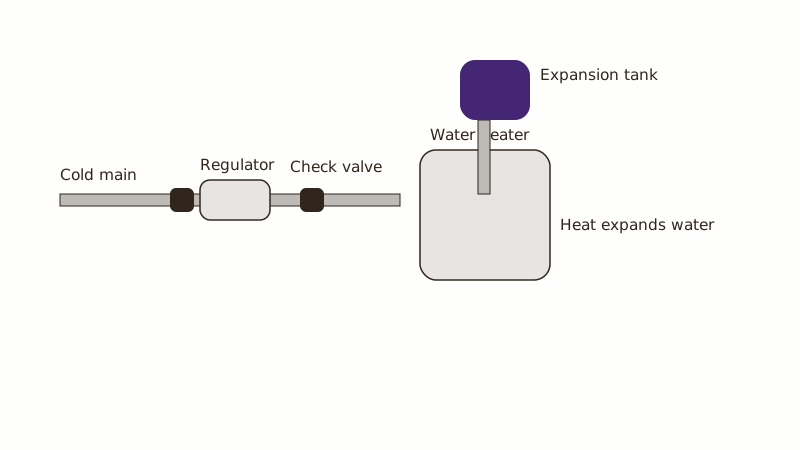
Watts offers a simple test: briefly open a cold tap. If pressure drops at once and returns to the set pressure, thermal expansion is the cause. That is why a replacement job often involves an expansion tank at the water heater. The job is described in replacing an expansion tank.
How often does a regulator need checking?
Manufacturers advise testing the valve on a schedule, at least yearly and more often if conditions demand, and following local codes. They note that corrosive water and unauthorized adjustments can make a regulator ineffective, and that cleaning internal parts, including the strainer, helps assure life and function.
Most owners read a gauge each year and swap the valve if it drifts or starts to whine. Hardness plays a role over time. Hardness averages 91 to 177 ppm in the city's 2025 report depending on source. Scale accumulates unevenly from house to house and can foul a valve seat. A plumber can tell whether cleaning or replacement is the better choice.
Can you replace a regulator yourself?
The Watts sheet states the valve should be installed in accordance with local codes and ordinances and requires you to consult the local building and plumbing codes first. You may do it with the right tools, but cutting supply pipe, soldering or fitting joints and testing pressure leave room for error.
The contractor board says a license is a must from $1,000 in work and parts, and for permit jobs of any size. A regulator swap is usually small, but ask the City of Ontario Building counter, (909) 395-2023, whether your address needs a permit. Hiring a plumber who measures pressure before and after is the safer route, and the quote is where the actual price lives.
What if low pressure is the problem, not high?
A failing regulator can also starve the house of pressure, especially when its strainer is clogged with debris, but low pressure has other causes: a partly closed shutoff, corroded galvanized pipe, a leak or a utility issue. Read static pressure at an outdoor spigot before blaming the regulator.
If a gauge shows healthy static pressure but flow is weak, look at fixtures and pipe. Read sudden low water pressure for the checks. If the static reading is low at the hose bib, the regulator, the main shutoff and the supply line are the suspects, and a plumber can narrow it down in one visit.
Common questions
How many years will a regulator run?
No single number applies. Water quality, pressure swings and installation all matter, and the maker advises periodic testing at least yearly. A regulator that is noisy, drifting or dripping at the body is a candidate. A static reading above 80 psi is a clear warning.
Is an expansion tank part of the deal?
Often, but not always. Fitting a regulator can close the system, and the manufacturer says a closed system may need relief protection in the form of a valve or tank. Have the plumber check for thermal expansion, and make sure any tank gets a line of its own in the price.
Can a regulator be adjusted instead of replaced?
Yes, if it is working. The Watts instructions describe loosening the lock nut and turning the adjusting bolt, then verifying with a gauge. A valve that drifts upward with every tap closed, or refuses to hold the number you set, is probably worn or fouled.
Why does the water pressure change through the day?
Street pressure rises at night and drops during heavy demand in many areas, and a worn regulator may fail to hold a steady setting. A gauge left on a hose bib overnight shows the pattern. Ask your water utility whether it has changed supply pressure.
Should the arrow face a certain way?
Yes. Watts says to install the valve with the arrow on the body pointing in the direction of flow, from supply side to the house. Installed backward, it will not regulate correctly. A plumber checks this on every job, and you should too if you handle the work yourself.