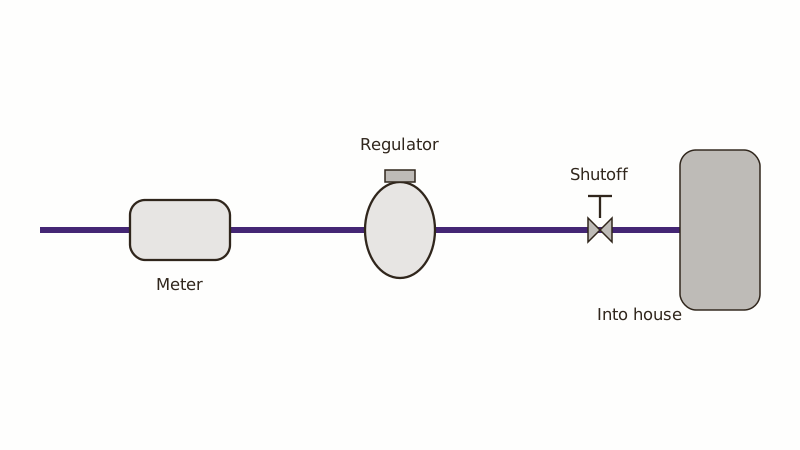
Trace the supply pipe inward from the street side of the lot and halt at the first big valve, the house shutoff. A regulator, where a house has one, normally sits on that same pipe a short way beyond the shutoff, before any branch heads to a fixture. That covers most homes. The places to look and a quick test follow, as part of our low water pressure help.
Where is the regulator usually found?
One California water district's FAQ says it is often on the main line inlet pipe, near the house shutoff valve, the customer valve, outside the home. Plenty are indoors instead, in a garage, crawlspace, basement or utility closet by the water entry, or near the water heater in slab-on-grade houses.
Since the unit sits close behind the main shutoff, you can close that valve before touching the regulator. Cannot spot it there? Scan the main line for a fatter, rounded body, often brass. Not every house has one.
How do I recognize it?
Typically a bell-shaped brass body, roughly fist-sized or a little larger, spliced into the pipe; the district's FAQ calls it bell shaped. Many carry an adjusting screw with a locknut on top, and some have a gauge port. Others sit in a ground-level valve box.
Do not confuse it with a shutoff, which has a lever or round handle, or with the expansion tank, a compact tank hanging off the cold line by the heater. If a shutoff is all you see, the house may have no regulator, or it may be farther along the pipe.
Does every house have one?
No. The district FAQ says builders must fit one once street main pressure exceeds 80 psi, and most come preset by the maker to 45 to 60 psi, which it calls optimal. Eighty psi is the ceiling in California's plumbing code, in its section 608.2. With lower street pressure, a house may not need one.
Roto-Rooter says home pressure typically runs 30 to 50 psi and should not exceed 60 psi, to avoid damaging pipes and fixtures. That is why a regulator matters in this area. The page on why pipes burst shows how high pressure shortens pipe life.
How do I check that the regulator is doing its job?
Put a gauge on an outside hose spigot while the house is quiet, then note the dial. About 45 to 60 psi is typical. Above 80 psi suggests the regulator has failed or is missing, while a low number suggests a clogged or worn regulator, a partly shut valve or a street supply problem.
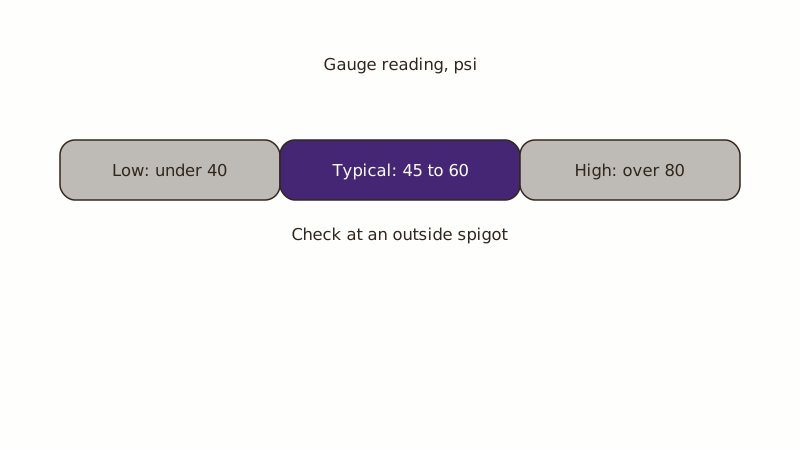
Hardware stores sell inexpensive gauges. Repeat the reading in the small hours as well, since pressure drifts across a day, and keep a note of each figure, with the time. The plumber will want them, and so will the water utility if you suspect the street supply.
Who is responsible for it, the utility or me?
You are. The water district FAQ says the regulator is the homeowner's private property, so the utility cannot adjust it, and a plumbing professional or supply store can help if an adjustment does not work. The utility is responsible for the main and meter; the owner is responsible for everything past the shutoff.
In Ontario, Ontario Municipal Utilities Company supplies and bills the water. For a pressure complaint at the street, call it. For a regulator on your own line, see a plumber. Our notes on adjusting a regulator explain the screw, and regulator replacement covers a swap.
Can an owner adjust it, or is that a plumber's task?
Some owners can manage an adjustment: back off the locknut, move the screw a hair, then recheck the gauge. Replacing the unit involves shutting the main, cutting pipe and fitting a new one, which most owners hand to a plumber. A seized screw should never be forced.
A contractor license is mandatory at $1,000 of labor and materials together, and permit jobs need one at any price. Whether a swap needs a permit is something to put to the Ontario Building counter, (909) 395-2023. For costs, see regulator installation cost. Our whole-house regulator page explains the types.
What if my pressure is low, not high?
A regulator set low, or clogged, can starve the house. A gauge reading under 40 psi with the main fully open could implicate the regulator, a shut valve or the supply. Water that arrives as a trickle at every tap, hot and cold, fits that picture. The order of checks is laid out in fixing low water pressure.
Do not assume the regulator is guilty; in an older neighborhood the pipes themselves are a frequent cause, and replacing galvanized pipe covers that. Clogged aerators, half-closed valves and aged pipes are commoner causes of weak flow. Test first, because a new regulator costs far more than a cheap gauge.
For other plumbing jobs, begin at the site home.
Common questions
How hard is it to find?
Usually minutes, once you trace the line inward from the meter. Inside a crawlspace or behind a finished wall it can take longer. When nothing turns up, a plumber can inspect the pipework and settle whether the house has one or should have one.
Which questions suit a regulator job?
Ask for a license number, the model, the pressure setting and the price breakdown, plus whether a permit applies. Ask too whether an expansion tank is also advised, and who tests the pressure afterward. Insist on every answer in writing.
Must someone be in?
An adult, to unlock access to the shutoff, the regulator and the hose spigot. If you cannot attend, a trusted adult may let the plumber in after the price is settled, and the supply to the house is closed briefly.
What goes wrong when it fails?
Pressure may swing from low to dangerously high, so taps spurt or knock and fittings leak, and pipes may wear faster. If you notice changes, test with a gauge, and have a plumber replace the unit when readings fall outside range.