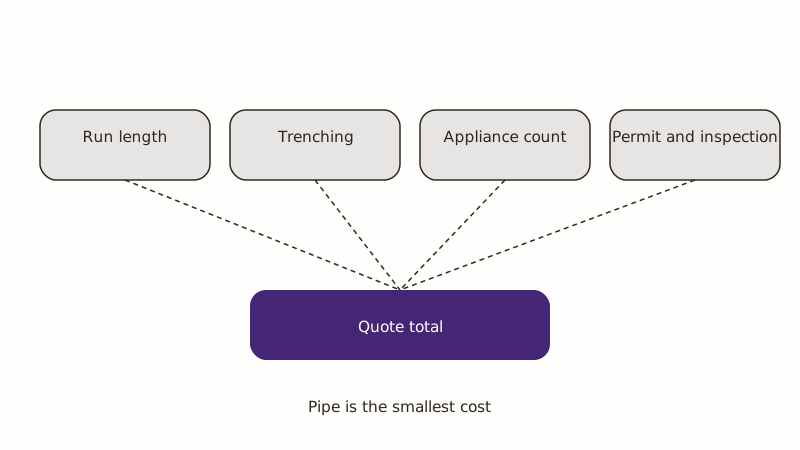
In the guides we read, a simple new gas line starts near $15 to $25 per installed foot, rising to $35 to $50 and beyond for buried or awkward runs. Pipe itself is minor. Trenching, permits and the appliance count move the total. Our gas line plumbing page covers the work, and this one prices each piece.
What is the price per foot?
HomeGuide, in the roundup we read, puts an easy-access new line near $15 to $25 each foot, and a hard run at $35 to $50 or more. Fixr lists extending an existing line at $10 to $20 a foot, and swapping an old line out at $23 to $35. Trenching adds roughly $5 to $15 a foot; boring beneath a driveway adds $10 to $30.
Per-foot numbers mislead on short runs. Setup and site prep dominate, so ten feet can cost nearly as much as twenty. For that reason one guide quotes a 10 to 30 foot extension as a flat $350 to $800, a sounder gauge for a small job than multiplying by length.
What does it cost to extend or run a new line?
Extending an existing line for a new appliance runs about $350 to $800 for 10 to 30 feet in one guide. A new service line from the street is another animal. One guide lists it at $2,000 to $10,000 and up, because it may cross a yard or sidewalk and bring in the utility. Which case applies sets the budget.
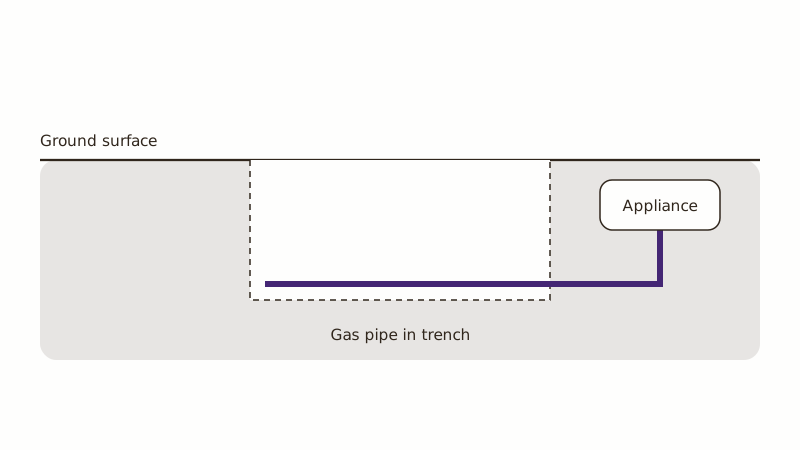
Another guide in the same roundup shows a much lower figure for a service line, so the sources disagree widely. Read that as a sign that your site decides the number. Walking the property is the only way a plumber can tell, with the gas utility handling the street side. SoCalGas serves Ontario, Chino, Montclair and Upland.
What do appliance hookups add?
Hooking a single appliance to a gas line is priced separately from running the pipe. HomeGuide's figures, as the roundup reports them, run from $400 to $900 for a dryer up to $1,500 and beyond for a furnace, generator or pool heater. The appliance itself is extra.
| Appliance | Hookup range |
|---|---|
| Stove or range | $500 to $1,200 |
| Clothes dryer | $400 to $900 |
| Water heater | $500 to $1,000 |
| Furnace | $600 to $1,500 |
| Fireplace | $500 to $1,000 and up |
| Grill or fire pit | $600 to $1,300 |
How much to replace all the gas lines in a house?
Whole-house gas piping with four or more appliances runs $2,200 to $7,500 in the HomeGuide figures, and $1,650 to $3,500 for five appliances plus a water heater in the Fixr figures. The spread reflects house size, pipe material, and whether lines run through walls, attic, crawlspace or under a slab.
Old black iron lines in older houses, such as those near Euclid Avenue or elsewhere in Ontario, Chino and Montclair, sometimes get replaced when a leak turns up or a remodel opens the walls. That usually needs a permit. Catch a whiff of gas and you should stand outside before dialing SoCalGas, 1-800-427-2200, ahead of any other call.
Does a gas plumber bill by the hour?
HomeGuide's figures for plumbers and gas fitters run $50 to $200 hourly; Fixr gives $75 to $130, and notes at least an hour is charged on a small job. Few gas jobs are priced purely by the hour, so a flat figure typically follows a look at the work.
State law ties permitted work to a licensed contractor, and gas piping often involves a permit. Ask for the license number and verify it with the CSLB. In Ontario the Building counter, (909) 395-2023, deals with permits. For the standards behind the work, read the code rules for gas piping.
What about earthquake shutoff valves and leak repair?
The guide we read gave no price for an earthquake shutoff valve or for repairing a gas leak, so we will not state any. Those are separate jobs from running a new line. Elsewhere on the site: earthquake gas shutoff valves, plus the steps for fitting one.
When the run to a range is short, a plumber may propose flexible gas line, described in half-inch flexible gas pipe. A gas smell or hissing goes to the utility first, ahead of any plumber.
What should a gas line quote include?
Look for the pipe type and length, the number of connections, trenching or wall repair if any, the permit and inspection, pressure testing and the appliance hookups. Ask whether patching drywall or concrete is covered, and who pulls the permit. Treat the guides above as a yardstick only. What you actually owe is set by the plumber's signed quote, drawn up after seeing the house.
Permit fees run $100 to $300 or more in one guide and $50 to $300 in another. Add inspections and appliance connections and the project total climbs further. Wonder why a quote shows no permit? Ask, because unpermitted gas work puts both you and a later buyer at risk.
Other plumbing topics are listed on the Chaffey Pipe and Drain home page.
Common questions
What drives a gas plumber's price?
Run length, access and the count of connections lead. Trenching, boring, finish repairs and permits stack on top. Most plumbers give a flat figure after a visit rather than an hourly rate. Lay your quotes alongside one another and confirm the permit appears in each.
What is inside a replacement quote?
Pipe, fittings, labor, a permit and inspection, pressure testing and repair of whatever was opened. Fixr's figure for swapping an old line is $23 to $35 a foot. With several appliances in the house, the whole job is often priced by connection, not just by the foot.
Does the work finish in a day?
A short extension to one appliance can often be finished in a day. Whole-house work or a trenched service line takes longer, and an inspection should come before the line goes into use. Ask for a schedule when you get the quote, and ask what follows a failed inspection.
Should I stay home?
Normally for the opening and closing of the visit. Access to the appliances and meter area is needed, and gas to the house goes off while work is underway. Expect stove, dryer and heater to be unusable for part of the day, then relit afterward.
Is gas piping a do-it-yourself job?
No. California ties gas piping to contractors holding a state license, plus permits, and we do not advise it. One slip can leave a leak that stays unnoticed until it is serious. Your part is checking the quote, asking for the permit and keeping the inspection paperwork.