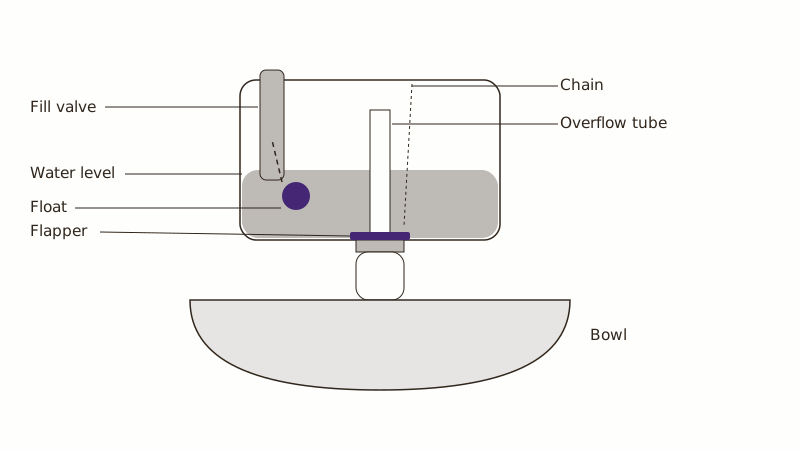
Move the lid off the tank and listen for thirty seconds. A thin stream running into the standpipe at the center says the float sits too high. Ripples crossing the bowl every few minutes, with the tank otherwise calm, say the rubber flapper underneath is seeping. These two causes account for most running toilets, and both are cheap parts. This guide extends the toilet repair overview with the checks in order, a rocking base, a full swap, and when a local plumber we arrange makes more sense. Rather hand the job over? Request a quote and describe the symptoms.
Which part is making my toilet run?
Use dye. Drip some dye into the tank and leave the handle alone for ten minutes. Color that creeps into the bowl proves a flapper leak. The EPA leak-week page suggests the same check. Dye in the bowl water blames the flapper, or the seat under it.
Clear bowl, yet the tank refills nonstop? Check where the water ends up. Lapping at the top of the standpipe, or a hiss from a full tank, means the fill valve overshoots. Work through it as dye, water level, chain, valve.
What do you do when the flapper will not seal?
Shut the small stop valve beside the tank, flush once, and press on the rubber. Slimy, curled or chalky means it has had its time. Rub the ring it lands on with the scratchy side of a sponge too, since mineral crust on that ring can leak just like a bad flapper.
The maker's kit instructions run in this sequence: water off, flush, mop up the leftovers, free the chain from the lever, slide the flapper off its pegs. New flapper on, chain re-attached with a touch of slack so it cannot prop the flapper open. Sizes differ, so carry the worn one into the hardware aisle.
Leave blue or bleach pucks out of the tank. Fluidmaster warns that bleach or chlorine products damage tank parts and can end in flooding.
Why does the tank keep topping itself up?
Some call it a phantom flush. Water seeps past the flapper, the tank sinks by degrees, and eventually the fill valve opens to restore it. The refill is so soft that you will not hear it from the next room, so most people learn about it from the water bill.
EPA lists the average home leak at more than 9,300 gallons yearly, and one seeping toilet can supply a good share. EPA also gives a meter test: note the dial, shut off every tap for two hours, look again. If the dial turns, water is escaping from some pipe or fixture, and the toilet makes a sensible first check.
How do you adjust a fill valve that overshoots?
The float is either a cup sliding on the valve shaft or a ball on a rod. Draw a pencil mark where the water stands now, which Fluidmaster's steps also suggest, then lower the float a notch using its clip or screw. One flush later you will see the new stopping point.
Set the stopping point a hair lower than the standpipe rim. If it overshoots anyway, the valve has worn out, and a new fill valve is an ordinary hardware-store part. Also look at the slim refill hose: it should clip to the rim, not hang down inside the standpipe, where it can siphon water away.
Why does my toilet wobble on the floor?
Shifting under your weight usually means a toilet with slack base bolts, a spent wax ring, or a floor with a dip. Tighten each nut in small increments, left side then right. Crank too hard and the porcelain splits, a worse bill than the wobble.
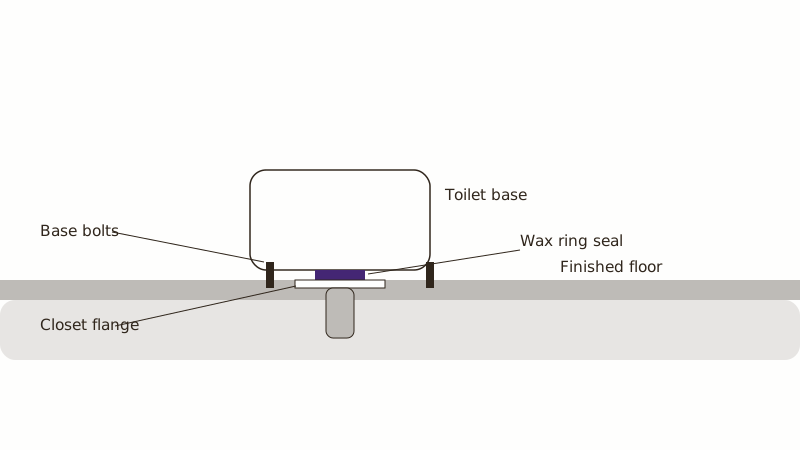
Still moving, or damp around the foot? Then the wax seal beneath is done. The cure is water off, bowl up and away, fresh ring, bowl back down. Porcelain is heavy and brittle, which is why many homeowners hire this out. Soft floorboards near the base come first on the to-do list, because moisture may have been seeping into them for months.
How is a toilet replaced from start to finish?
The sequence: stop the supply, drain tank and bowl, detach the hose, undo the base nuts, tilt the old unit off the flange. Scrape the flange clean, press a new ring in place, lower the new bowl, snug the nuts evenly, reconnect water. Stay nearby for an hour and watch for drips.
Weight is the catch, since a full-size toilet wants two lifters, and a cracked flange or soft floor can stretch an hour into a day. Weigh it against the page on what a toilet replacement costs. On permits, ask the City of Ontario Building office; the building division can say whether a straight swap of the old toilet needs one.
Does a running toilet mean a plumbing or a heating problem?
Plumbing, always. A heating contractor handles furnaces and ducts. Drainage services, toilet repair and fixtures are plumber work. If you also lack hot water at the taps, that is a separate fault in the water heater, covered in water heater repair.
Tell us where the trouble shows up when you call, whether tank, floor or wall. Our service sends a local plumber, with the price confirmed in writing before anyone shows.
Common questions
Why is it still running after I jiggle the handle?
Wiggling merely frees a snagged chain. If the noise is back within a minute, the flapper leaks or the float is too high. Do the dye test, then compare tank level to the standpipe. One of those two usually points straight at the cause.
How long does a running toilet repair take?
Fifteen minutes for a flapper once you hold the part. A fill valve runs nearer an hour, because the supply line comes off and the height of the new valve needs setting. A plumber who brings parts normally finishes in one visit.
Can a running toilet raise my water bill?
Yes, and quietly. A seeping flapper works around the clock without making a sound, so the first hint is usually the bill. If your usage has not changed but the charge has risen, try the dye test before checking elsewhere, because the toilet is a very common source.
Are in-tank bleach tablets safe for the toilet?
No. The maker's own instructions warn that in-tank cleaners with bleach or chlorine damage components and may lead to flooding. They are also hard on rubber parts. Clean the bowl with a brush and a bowl product, and keep anything that soaks out of the tank.
Should I give up and call a plumber?
After a new flapper and a lowered float fail, or water pools at the base, or the porcelain is cracked, or the shutoff will not turn. Older shutoffs can seize, and forcing one can start a leak you cannot stop.