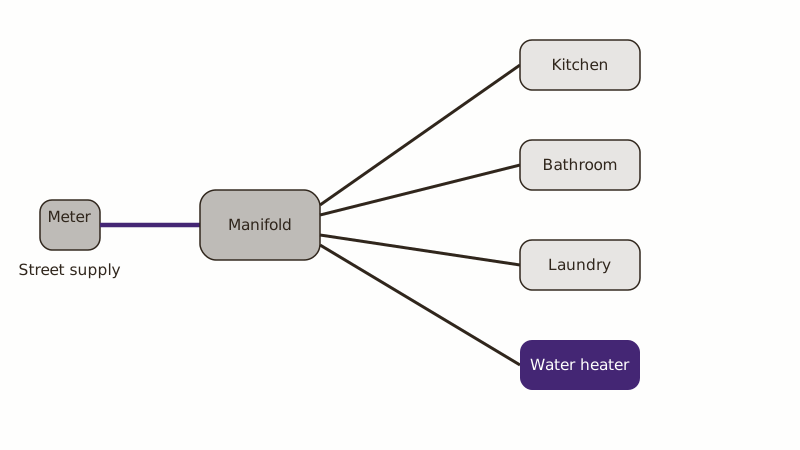
In a repipe, the pressurized supply lines inside the walls are abandoned or pulled, and new ones are run from the meter side out to each faucet. It is a project for houses whose lines are leaking repeatedly, running brown, or made from a material known to fail. At Chaffey Pipe and Drain we line up the visit and the estimate, and the work itself belongs to a local plumber. Below you will find what goes in now, how the job unfolds, and what points to a repipe.
What pipe goes into houses now, in place of old copper and steel?
Most residential repipes in California use PEX, a bendable tubing of cross-linked polyethylene, or copper. PEX is lower in cost to put in and curves around framing, which leaves fewer joints buried in the walls. Copper is rigid, soldered at every joint, and has the longest track record. Galvanized steel and polybutylene are the pair being pulled out.
PEX shows up in many new subdivisions, and newer Ontario Ranch and Preserve homes may well carry it. Chlorine, pressure and heat are what shorten its life, and its fittings are the weak point, not the tube. Copper holds up for generations in many water supplies but can pit where water is aggressive. Our side-by-side on PEX versus copper weighs these two against each other for Inland Empire water.
How do I know the house needs new water lines?
Look for repeated leaks in different spots, brown water at the tap when nobody has run water for a while, thin flow throughout the house, not just at one fixture, green crust or pinholes on exposed copper, and polybutylene, a gray or bluish plastic stamped with the maker's code, visible near the heater or under a vanity. One leak alone rarely justifies tearing out everything.
Age helps predict. Houses near Euclid Avenue and the older blocks of downtown Ontario, and postwar tract homes in Montclair and Chino, have the best odds of still carrying galvanized steel, which closes up from the inside as mineral scale and rust build. A choking galvanized line often announces itself when the shower dwindles as soon as the dishwasher starts. Our page on why a house gets repiped lists the triggers one by one, and the repipe interval question explains why there is no fixed calendar.
How does a repipe job actually go?
Picture four things: a walk-through, a permit, one or more days without running water, and wall patching afterward. A crew maps the new routes, cuts small access holes, runs new line to each fixture, tests it under pressure, and calls for inspection before the openings are closed. Inside Ontario, the city's Building office, (909) 395-2023, issues the permit.
Contractor write-ups usually put an average PEX house at a day or two of pipe work, sometimes more. Copper runs slower, since every joint is sweated shut with a torch. Drywall patching and paint are often not in the plumber's quote, so ask. For a hands-on view of the stages read how a house is repiped. Many crews turn water back on each evening, but ask whether yours will.
Is a repipe worth the money, and what is the cheapest route?
PEX is generally the lower-cost route, and doing a repipe in one stage costs less than a series of leak patches that never stop. Whether it pays depends on how often the old lines fail and what each failure damages. A house with one tired section can sometimes be partly repiped, which is a different quote from a whole-house job.
No dollar range appears here, because we have no published figure that holds across house sizes and wall types. The variables are bathroom count, one story or two, slab or crawlspace, plaster walls or drywall, pipe material, and permit fees. Sorting those is what the quote is for; repipe cost in Ontario and PEX repipe cost work through them in more depth. What counts is the figure a local plumber commits to on paper once the house has been seen.
What do I do about polybutylene or galvanized lines?
Treat both as pipe you plan to replace. Polybutylene, a gray plastic laid in many houses built during the late 1970s through the mid 1990s, can deteriorate inside the tube with nothing visible outside. The large national class action over it has closed and no claim deadline is open, so replacement is the homeowner's cost. Galvanized steel corrodes and chokes the flow.
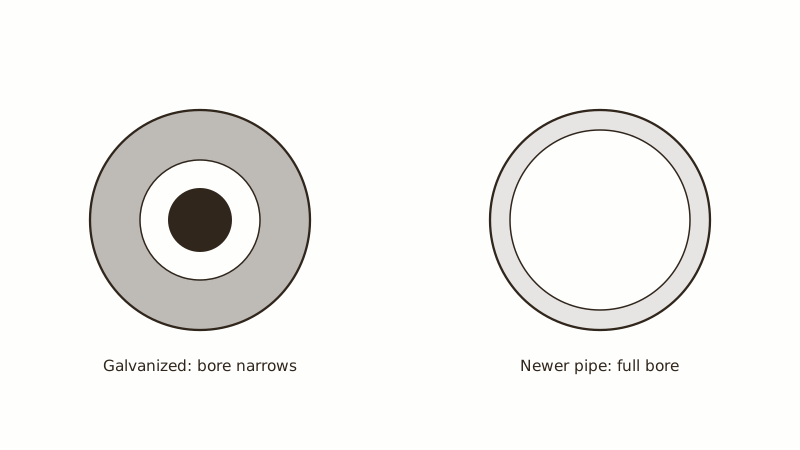
Neither fails on a timetable, but both are poor candidates for another decade of repairs. Pointers: polybutylene pipe replacement covers how to recognize that plastic, and galvanized pipe replacement handles steel lines. Buying a house that has either one? Put a plumbing inspection into the contract timeline.
Can I replace the pipes myself?
Technically a handy owner can run PEX, but a full repipe usually triggers a city permit, and permitted work is reserved by state law for a contractor with a license. Beyond the law, the work means opening ceilings and walls, bonding and testing the system, connecting at the main and at the heater, and passing inspection. An unpermitted repipe can cause trouble at resale.
Small, visible jobs, such as swapping a supply line under a sink, are different and are fine for many owners. Anything buried, anything at the main, and anything with gas nearby should go to a contractor. Ahead of signing, check the contractor at the state licensing board, and have the scope, material and who patches the walls spelled out on paper.
What about the cost of copper by the pound?
Scrap copper is priced by weight and moves from day to day, so any figure printed here would be stale quickly. Old copper pipe pulled from a repipe has some scrap value, but it is small next to the cost of the job. See whether the plumber credits scrap against the quote, and call a local recycler for today's rate.
Common questions
Where does the "135 rule" come from?
We found nothing in the California Plumbing Code under that name, so any definition we gave would be a guess. Tradespeople sometimes use their own shorthand for drain angles or fitting turns, and it differs from one shop to the next. Seen it on a quote or an inspection note? Ask the author which code section is meant.
Should I flush or clean my house pipes on a schedule?
Water supply lines are not cleaned on a schedule; they are replaced when they fail. Drains are different. Slow drains, gurgling and odors call for drain cleaning, and the work often involves a snake or a camera. If the problem is water pressure or discolored water, think supply lines and the pressure regulator before the drain.
Do copper pipes ever need to be replaced?
Yes, in some homes. Copper often lasts for decades, but aggressive water, high velocity or poor soldering can lead to pinholes and green stains at joints. A single pinhole can be repaired. A pattern of leaks across several rooms points to a failing system, and that is when homeowners compare a repipe against repeated service calls.
Could an owner swap out the house sewer line alone?
The sewer line is the drain that leaves the house, not the pressurized water supply, and work on it typically involves a permit and a trench, and sometimes the city where it crosses the street or easement. Owners usually hand it to a contractor. Phone Ontario Building, (909) 395-2023, to learn what applies to your address.
Is copper or PEX the better choice?
Neither wins in every house. PEX costs less and resists some corrosion, but fittings and sun exposure matter. Copper lasts long and tolerates heat, but costs more and can pit in aggressive water. Ask the plumber which they would use in your walls and why, and get that choice written into the quote.