Hourly rates put a price on a plumber's time, yet on a commercial site that figure seldom predicts the invoice. Trip charges, materials, permits, after-hours multipliers and the second person on the job all sit beside it. Our page on commercial emergency plumbing in Ontario covers urgent calls, and this one deals only with how the money works.
What hourly rate should a business expect in Ontario?
We have no published, checked hourly figure for commercial work in the Ontario area, so none is printed here. Rates differ by company, by trade level, and by whether the call is routine, scheduled or urgent. Only a quote on paper, written by a local plumber who has walked the building, should drive a decision.
One public anchor exists, and it is a wage, not a rate. Across the country, the median plumber, pipefitter or steamfitter earned $30.67 an hour in May 2025, according to federal labor statistics. A company bills well above its workers' pay because the rate funds the vehicle, tools, insurance, dispatch, warranty callbacks and office time. Use the wage figure to see that a rate which looks high may still be fair, not to calculate a bill.
Why do rates differ between a master, a journeyman and an apprentice?
Training and responsibility. The same federal source says most people enter the trade through apprenticeships lasting four to five years, with around 2,000 hours of paid on-the-job work per year plus classes. More experienced plumbers run the job, read plans and sign off on work, so their hours are priced higher than those of a helper carrying pipe.
Many commercial quotes list a lead plumber and a second person separately, and some bundle them into a blended rate. Both are legitimate; just work out which one is in front of you. Ask who will arrive, what their role is, and whether the hourly figure covers one person or a crew. A line that reads "two hours" could mean two or four labor hours.
What pushes a commercial plumbing bill up or down?
Access, hours, scale and rules. A rooftop unit or a ceiling crawl costs more time than a ground-floor valve. Scheduling around business hours, in the evening or on a Sunday, adds a surcharge. A restaurant grease line, a medical suite and a warehouse restroom block each need different parts and different permits.
Other drivers to expect on a quote:
- Trip or dispatch fees, charged once per visit
- A floor on billable hours per visit
- Materials marked up from the plumber's own cost
- Permit and inspection fees, often passed through
- Specialty gear, including inspection cameras, jetting rigs and pipe locators
- Backflow device testing, which some water suppliers require yearly; see commercial backflow testing
- Coordination with a landlord, the property manager or the building engineer
Newer industrial and logistics space around the airport district, including the Meredith International Centre, a 257-acre plan of seven buildings and about three million square feet, is newer space, so its piping is likely more recent. Older storefronts near downtown Ontario may hide undersized or aged piping that raises the scope once a wall opens. Both are covered in our pages on the airport and Meredith area and downtown Ontario.
Is a flat price or an hourly rate better for my job?
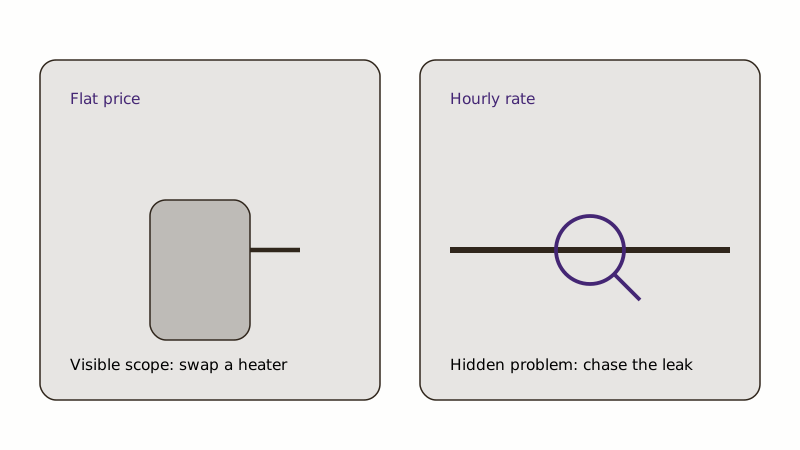
A flat price fits a task with edges, like swapping out a water heater, where what is needed is visible. Hourly billing suits diagnosis and unpredictable work, such as chasing a leak. Neither is automatically cheaper. A flat bid transfers the risk to the plumber, and a good one will say what it excludes.
For repairs inside an occupied business, request a capped estimate: an hourly rate with a ceiling that cannot be crossed without your say-so. It protects you without forcing the plumber to guess. For tenant improvements and new construction, expect a bid built from drawings, with materials, labor, permits and a contingency listed separately. Weigh them by what each includes, not only by the total.
How should I weigh competing bids?
Put the same scope in front of each plumber, then compare four lines: labor basis, materials, permits and exclusions. The cheapest total is not the best deal if it leaves out a permit, a patch or cleanup. Ask each plumber to describe the work in a sentence you could read to your landlord.
Questions that make quotes comparable:
- Is the rate per person, per hour, and is there a minimum?
- What does the trip fee buy, and is it credited toward the repair?
- Which party files for the permit, and is that cost in the total?
- What is excluded, such as drywall, painting or roof access?
- Is after-hours work priced differently, and from what hour?
- Which part of the bill changes if the job runs long?
Take a second look at any quote that cannot answer these in writing. Ontario's Building office, (909) 395-2023, can tell you if permit rules touch your job, and your water supplier, often the Ontario municipal utility at (909) 395-2600, can say if a backflow device or a sewer connection is involved.
Does the size of the building change the rate?
Not usually the rate itself, but the scope. A larger site means longer pipe runs, more fixtures, more shutoff coordination and more risk of a second problem. The rate might be the same as for a small shop, while the hours multiply. Ask whether a property-wide agreement, such as a maintenance contract or planned visits, changes the price per visit.
Common questions
When is a quoted rate reasonable?
A fair price is one you can explain: a clear rate, a stated minimum, a stated trip charge and a described scope. We cannot give a trustworthy dollar figure for Ontario without a quote in hand. Have two or three local firms price an identical job on paper, then read the line items and the exclusions.
Will an evening call cost extra?
Frequently. Evening and weekend visits tend to carry a higher rate, and some shops add a minimum for them. Ask when the premium starts and ends, whether it applies to travel time and whether the same rate is used for follow-up visits. If the leak can wait until morning, shutting the water off may save money.
What details help the plumber price the visit?
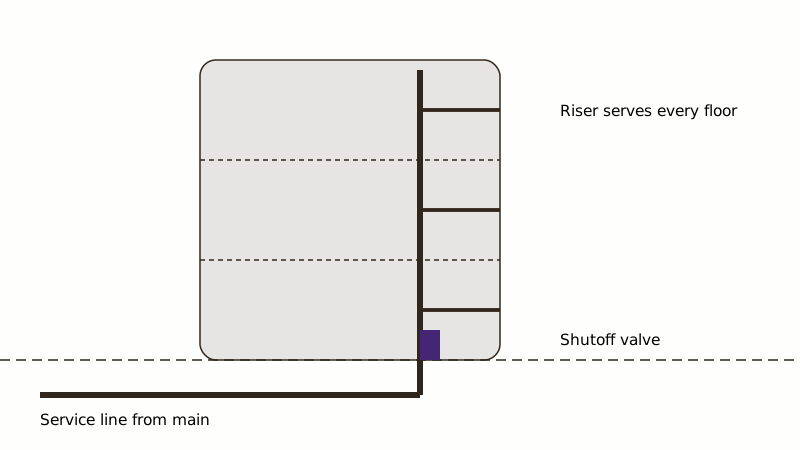
Have the address, a short description of the problem, where the shutoff valve is, how the space is used and who can approve cost. Photos help. For a restaurant, say what the drain serves. For a multi-tenant building, say whether the landlord owns the pipe. The plumber can then give a more realistic range for the visit.
Is a master plumber's rate worth paying?
For design, diagnosis and permitted work it often is, since that person is responsible for decisions and sign-off. For something simple, like opening a clogged drain, a lower-rate team member may be enough. Find out who is coming and in what capacity, and weigh the roles against the charge.