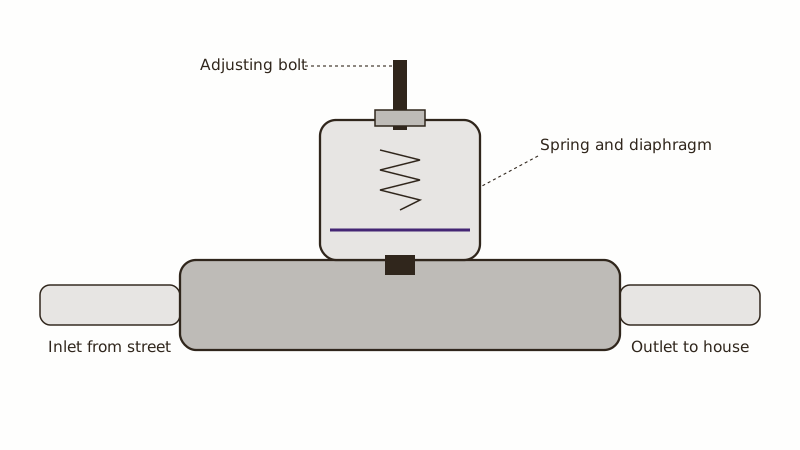
The routine: screw a gauge to the outdoor faucet nearest the street, record the number while the house sits idle, slacken the nut above the bell-shaped valve, then rotate the bolt: turned one way the pressure goes up, the other way it drops (clockwise is up). Tiny turns, a fresh reading each time, then lock it. If the pressure is the real problem, start with low water pressure; home is the starting point for booking help.
Will adjusting the regulator stop water hammer?
Sometimes it quiets it, but it will not cure it. Banging pipes come from a fast-closing valve stopping a moving column of water, and high pressure makes the bang worse. Lowering an over-set regulator can soften the knock. If the sound survives a sensible setting, hammer arrestors are the usual next step.
Watch what the bang does when pressure drops. If it fades, pressure was the amplifier. If nothing changes, look at the fixture that slams: dishwashers, washing machines and single-lever faucets are the usual suspects.
A regulator also does nothing about the hammer caused by loose, unstrapped pipe in a wall. That one needs a plumber with access to the framing.
How do you actually adjust the valve?
Borrow a screw-on gauge, fit it to a hose bib, make sure nothing is running indoors, and note the dial. Back at the regulator, back off the locknut and nudge the adjusting bolt a sliver, then re-read. Once the needle lands on your target, snug the nut down.
Watts, a major valve maker, publishes this procedure for its Series PRV-1: the valve leaves the factory at 50 psi, and the bolt direction is the same as above. Its sheet also insists on a gauge downstream to set and confirm the pressure.
A few habits keep you out of trouble:
- Make eighth-turn moves, then wait for the gauge to settle.
- Never run the screw all the way down onto the spring cage.
- Re-check at the hose bib with all taps closed, since flowing water reads lower.
- Write the final setting on a piece of tape near the valve.
What pressure should the setting be?
Code section 608.2 in California's plumbing rules caps building water pressure at 80 psi, so aim for a number well under that cap. Factory presets, such as the 50 psi on the Watts valve above, show the usual territory, and a reading sitting right at the cap leaves no margin.
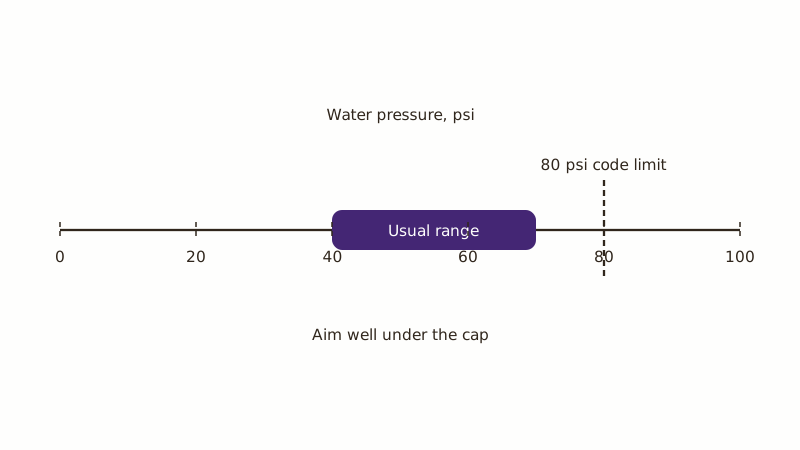
Higher is not better. Pressure near the limit strains relief valves, tank fill valves, washing-machine hoses and aging soldered joints, and it pushes more water through every small leak. Setting it too low has its own cost: weak showers and sluggish upstairs faucets.
Check the whole-house figure before you blame the city. Ontario's water comes from a mix of wells and imported supply, and pressure can differ by street and by elevation, so a reading at your own spigot is the only reliable number.
Where do you find the regulator in your house?
Search right behind the main shutoff. Picture a squat brass bell, bolt and locknut poking from its crown, bolted onto the line that brings water in. Garages, side yards in a utility box and the front hose bib area are the usual places in Ontario and Chino homes.
A few houses lack one entirely, particularly where street pressure is modest.
If you cannot find it in ten minutes, trace the pipe from the shutoff in the direction the water flows. The first fat bell is the one you want. Our page on finding the regulator has more detail.
How long can a regulator be expected to work?
No single figure applies, and a flat promise deserves suspicion. The internal diaphragm and seat wear out with use and with grit in the supply. Some last well over a decade, some fail sooner where debris is heavy. Watch the symptoms rather than the calendar.
The signs: pressure that creeps up overnight, pressure that swings between taps, a whistling or humming at the valve, or a sudden drop to a trickle. Manufacturers sell seat and stem repair modules and a replaceable strainer, so a worn valve is sometimes serviced rather than swapped.
Creep can also come from thermal expansion. The Watts sheet explains that heated water expands in a closed system, and that a relief valve or a potable water expansion tank may be required. See expansion tank replacement if your reading rises when the heater runs.
Does every house need a regulator?
Only when the incoming pressure runs higher than the code allows. If a reading at the hose bib stays under 80 psi with no flow, the code limit is met without one. Supply pressure can climb on hills or near pumps, which is one reason some homes carry a regulator.
Take two readings, one early and one in the evening, since street pressure drifts through the day. If the high reading is consistent, you need a regulator or you need to replace the failing one.
Homes in newer districts such as Ontario Ranch may or may not have one fitted at build; older houses near the downtown core may carry one from an earlier repipe, or none.
Can you replace or install a regulator yourself?
Handy owners swap them, but the manufacturer's own sheet says the valve should be installed by a contractor in accordance with local codes. Treat that as the safe reading. Phone your city's building division to ask if a permit comes into it, and bring in a plumber whenever the main line has to be opened.
Permitted work in California must go to a contractor-license holder; so must any job that, parts included, hits the $1,000 mark. The main pipe carries full street pressure, so one botched fitting can flood a garage within minutes. Ontario Building takes calls at (909) 395-2023.
For costs, see regulator installation cost and replacement.
What about regulators for pumps, shower heads and hoses?
A booster pump carries its own pressure switch, and that is a separate topic for whoever installed the pump. A shower head regulator is really a flow restrictor, not a pressure device, so it will not fix a low-pressure complaint. Hose-end regulators are small fittings for irrigation lines.
None of these replace the whole-house valve. They manage one fixture, one line or one pump. When all the taps misbehave together, suspect the main line and read about a whole-house regulator.
Common questions
Is a regulator swap a quick visit?
A direct swap near an accessible shutoff is quick; reworking pipe, adding unions or digging at the meter box stretches it. We cannot promise a duration. The plumber should estimate it once they see the valve, and the number goes in the written quote.
What belongs on your list of questions for the installer?
Which valve will go in, which setting will it get, and how will they prove it with a gauge? Does the price cover unions, a strainer and any permit paperwork? Is the trip fee credited? Expect a license number and a paper quote ahead of any digging or cutting.
Should somebody be at home during the swap?
Preferably, at least for the opening: the plumber wants the shutoff shown and the price agreed, and the supply is shut during the swap. If the valve hides behind a locked garage door or side gate, sort out access beforehand and pass along any gauge readings you took.
Is high pressure damaging my fixtures?
Over the long haul, yes. Readings beyond the 80 psi code limit wear hoses, fill valves and the heater, and small leaks can open up. A high reading means adjusting or replacing the regulator. Pressure that is oddly low points elsewhere; try why pressure drops.