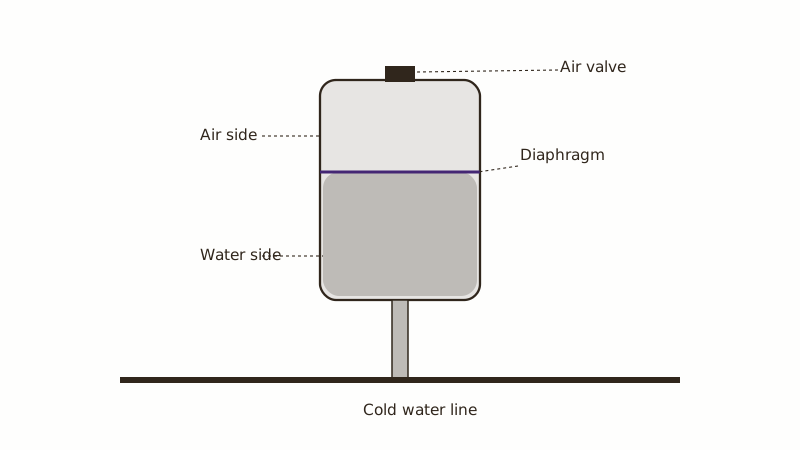
Picture a squat steel canister, painted blue or red, tapped into the cold-side plumbing beside the tank. Inside, a rubber diaphragm separates a pocket of air from the water, and that air pocket is the whole trick: it flexes when heated water swells. Once the air side is lost, the tank is dead weight and should be replaced. It is one topic among many in the water heater repair section.
Why does a heater setup need this canister at all?
Hot water occupies more volume than cold. If the house can push that swelling back toward the street, nothing happens. If a one-way device blocks the route, the pressure spikes whenever the burner or element fires, and the squeeze lands on the heater, the fixtures and the relief valve. The tank is a cushion for that squeeze.
Watts, a valve maker, describes this in the instructions for its pressure reducing valves. Thermal expansion occurs whenever water is heated in a closed system, and a system counts as closed once a one-way valve or backflow preventer is installed on the incoming line. The sheet adds that a relief valve or a potable water expansion tank may be required.
Without a cushion, the heater's relief valve is the only release. It may dribble every cycle, and a valve that dribbles is a valve wearing out.
Could you swap it on a Saturday?
Plenty of capable owners do. You shut the water, drain a little line, unthread the old canister, thread on the new one with sealant tape, set its air charge and refill. The job stops being yours at gas piping, or at any work needing a permit, both of which go to a contractor.
Two details separate a tidy job from a leaky one. The air charge inside the tank should be set to match your house pressure, measured with a tire gauge at the air valve while the tank is off the pipe, as the maker directs. And a full tank is heavy, so it should be supported as the instructions direct instead of dangling from one threaded fitting.
Permits are the city's call. Under state rules, permitted work needs a contractor license, as does any job that totals $1,000 with materials counted. A tank swap is commonly a small job, though if the wider heater work needs a permit, the whole package does. Not comfortable draining and recharging? A plumber can finish quickly and test the pressure while on site.
Is one required at your house?
Often needed, not automatically. Homes with a one-way device on the supply are the textbook case. A house without one can sometimes let the swelling flow backward. We will not call it a code mandate, because rules and your piping decide, and we have not seen your meter.
One way to find out: inspect the pipe near the meter or heater for a backflow device, a one-way valve or a regulator that includes a check. Another: thread a test gauge onto an outdoor spigot, run a hot shower until the heater fires, and watch the needle rise.
For the official answer at your address, phone the city. Ontario's Building office is at (909) 395-2023, and Chino's Building Division at 909-334-3251. Say what kind of tank heater you own, then ask what applies to replacements or added tanks.
How do you find out whether your tank is spent?
Look at the air valve, tap the shell, and watch your gauge. A healthy tank puffs air from its small top valve and sounds hollow in the upper half when tapped. A waterlogged one spits water from that valve and thuds all the way down.
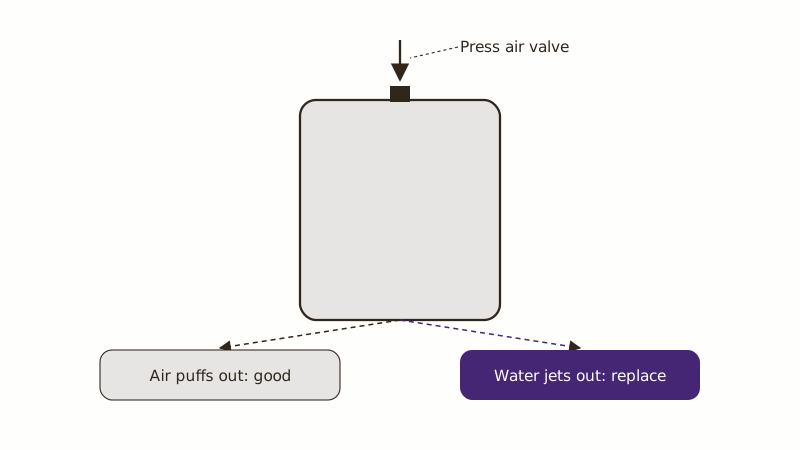
A bench test:
- Kill the heater (breaker or gas dial), then close its cold feed.
- Crack a hot faucet briefly so the plumbing relaxes.
- Press the stem of the air valve with a fingertip, as on a bicycle tire. Air is good. A jet of water points to a ruptured diaphragm.
- Rap the shell with a knuckle, top then bottom, and listen.
Symptoms outside the tank tell the same story: a relief valve that weeps, pipes that knock whenever the heater fires, or a gauge needle that leaps. Watts suggests a quick check for thermal expansion: briefly crack a cold tap, and if the pressure falls away at once, expansion was the cause.
Remember the ceiling, too. The state plumbing code caps building pressure at 80 psi (its section 608.2), so a spike heading that way is worth chasing.
What does a replacement tank cost?
A national cost guide shows an expansion tank at $80 to $150 installed when it rides along on a water heater job. A separate visit for the tank alone often costs more, because the trip fee is spread over one small task, and cramped piping adds time. Read the range as a ballpark only.
That guide is an April 2026 snapshot and lists the tank as a common extra on heater swaps. The final number depends on the plumber, the location in your garage or closet and what else needs changing. Put plainly, the figure on the quote is the price, and it appears only after a local plumber inspects your setup.
When comparing quotes, see whether the tank, fittings, a pressure check and removal of the old canister are all in the price. If someone proposes a bigger tank, find out why.
Which tank should go on?
Size depends on the heater's capacity and on your house pressure, so no single answer fits every home. Let the plumber match the tank to the heater, and read its label for volume and pressure rating. Pick one made for potable drinking water, since some canisters are built for heating loops only.
Orientation matters too. Vertical and horizontal mounting both exist, and heavier models need real support. Follow the maker's sheet for the position the unit was designed for.
If your house pressure sits above the tank's precharge, the cushion collapses early, so know your reading. A high number can be tamed, and this regulator walkthrough shows how.
Should it be replaced when the heater is?
Frequently. A tank swap costs little when the system is already drained, so many plumbers suggest a new canister whenever a new heater goes in, particularly if the old one has been in service for years. A waterlogged cushion would leave the new heater's relief valve doing all the work.
Have the plumber inspect the old one first. A tank that passes the air test can stay. For timing, the Department of Energy gives tank heaters 10 to 15 years, so an aged heater and an aged cushion tank frequently retire together; replacement timing explains the signs.
A dripping relief valve is often the first symptom, and relief valve replacement covers that part. Pricing for the heater itself sits on the replacement cost page.
Common questions
How long before the cushion tank wears out?
No lifespan figure we can source exists. Some canisters work for many years while others fail early, depending on pressure, temperature and build quality. Press the air valve once a year, and again whenever the relief valve drips. If water emerges, retire the tank and fit a new one.
What goes wrong when the tank has failed?
Pressure has no cushion during heating, so the relief valve may leak, pipes can knock and fixtures wear faster. The heater itself may be strained over time. It is seldom an emergency, but a relief valve that drips regularly should be dealt with before it fails or soaks a floor.
Is it safe to take it off and leave it off?
Not on a closed system. Without the canister, the heater's relief valve alone handles every pressure rise, and it may begin to leak. A bad tank should be replaced. If your plumbing turns out to be open, a plumber can confirm that you do not need one at all.
What is the sensible first step?
Run the air valve test, note whether the relief valve drips, and record the pressure from your outdoor gauge reading. Then have a plumber fit a replacement, ideally during any heater visit. The quote page gets that going, and the home page lays out the whole service.