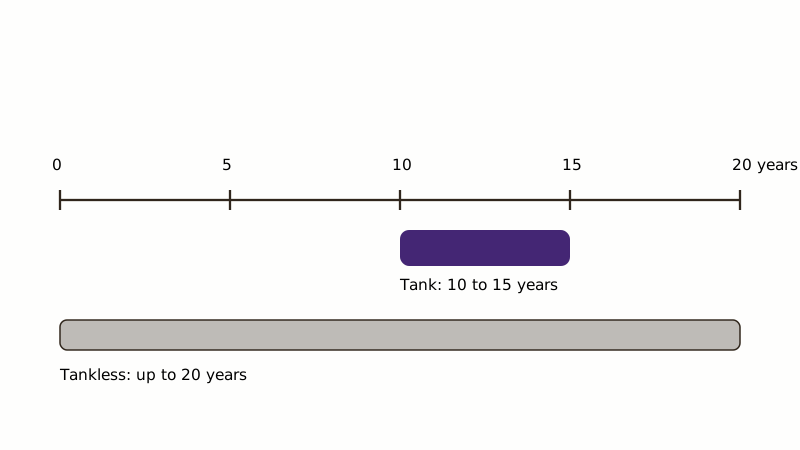
Budget on a decade to fifteen years for a conventional tank, and up to twenty for a tankless unit, going by the Department of Energy's building guidance. Those figures describe typical life, not a countdown. A tank in soft water with a healthy anode can beat them; one in hard water can fall short. You are reading a branch of the water heater repair section; to ask for a visit, begin at the home page.
At what age should you start planning a replacement?
Begin thinking around year ten for a tank, and watch for symptoms after that. The Department of Energy's range for tank-type heaters is 10 to 15 years, which makes the later part of that stretch the likeliest time for a failure. You are not obliged to replace at ten; you are wise to be ready.
Here is a rough ladder for a tank heater:
| Age | What to do |
|---|---|
| Under 6 years | Nothing but an occasional look for drips |
| 6 to 10 years | Test the relief valve, check the anode rod, look at the base |
| 10 to 15 years | Budget now; replace on the first leak or repeated repair |
| Over 15 years | Treat every day as bonus time, and keep towels near |
Working out the age is easy. A sticker on the tank carries a serial number in which most brands tuck the date the tank was built. A faded sticker is no obstacle, since the maker's support line can decode the number from a photo.
Is flushing worthwhile on a heater that is ten or older?
Often, with caution. Draining clears out sediment and may win back some efficiency. Yet on a tank nobody has ever drained, an old crusty valve can start to drip the moment you open it. Examine the valve first, and keep a plumber's number ready in case it refuses to close.
Flushing is generally a small maintenance task, not a way to rescue a failing tank. If the unit is already weeping from a seam, flushing will not help.
If a tank is past ten and the sediment is thick, let a plumber handle the first drain, since a spare valve rides in the truck. A yearly routine is easier afterward. This is trade experience rather than a regulated rule, and the manufacturer's manual sets the actual schedule for your model.
Do tankless water heaters need flushing too?
Yes, and they need it more urgently in hard water. The Department of Energy's guideline says scale builds up inside the copper heat exchanger of a tankless heater and can restrict flow and shorten the unit's life. Follow the maker's schedule, since flushing intervals differ by model and by water.
Some manufacturers set a hardness limit for warranty coverage, and a few ask for a softener above it. Check the limit in your own warranty before you install a tankless unit, and compare it with your utility's report.
Most tankless owners do the flush with a pump, a bucket and a descaling solution that the manufacturer approves. If the manual calls for a specific product, use that one. For service questions, see tankless water heater service.
Is it worth switching to a tankless unit at replacement time?
Sometimes. Energy savings from tankless units depend on the model and how much hot water you use, and tankless units tend to last longer. But they cost more up front, need more gas or electrical capacity, and are fussier about hard water. Weigh the trade-offs in tank versus tankless.
If you decide to replace, price it by getting a written quote on replacement cost and an itemized visit from the quote page.
Why do some tanks die early in this area?
Mineral scale is the big one. According to the USGS, hot hard water deposits calcium carbonate inside equipment, trimming its life and, in electric heaters, its efficiency. Ontario's utility measured average hardness between 91 and 177 ppm in 2025, depending on the source of the water. On the USGS scale, anything from 121 to 180 mg/L counts as hard.
Other utilities near us tell a similar story. Monte Vista Water District reports a 2025 average of 135 ppm in Montclair, and Upland's 2024 report gives 163 ppm, with ranges that go much higher at individual sources. Your own tap may differ, so find the water quality report issued by the utility that bills you.
Three further culprits: a used-up anode rod, excess water pressure and years of high thermostat settings. For the first, read about anode rod replacement; for the second, see how to adjust the pressure regulator.
Is flushing a job for the homeowner?
For a tank unit, yes; many owners manage it. Cut the power or turn gas to pilot, shut the cold inlet, screw a hose onto the drain, aim it outdoors, crack a hot faucet and let the tank empty. Pulse the inlet to stir the last silt, close the drain, refill, and switch power on again after the tank has filled.
Never power an electric element on an empty tank; it burns out in moments. Let the hot faucet run until the stream steadies, the sign that air has left the lines.
Hot water scalds, so let the tank cool for an hour before draining. Treat gas relighting as a manual's job, not a guess; a pilot that refuses to catch means someone qualified is needed. Replacing the heater itself involves a permit in most California cities, so ask the city building division, for instance Ontario's at (909) 395-2023.
Which symptoms say the heater is finished?
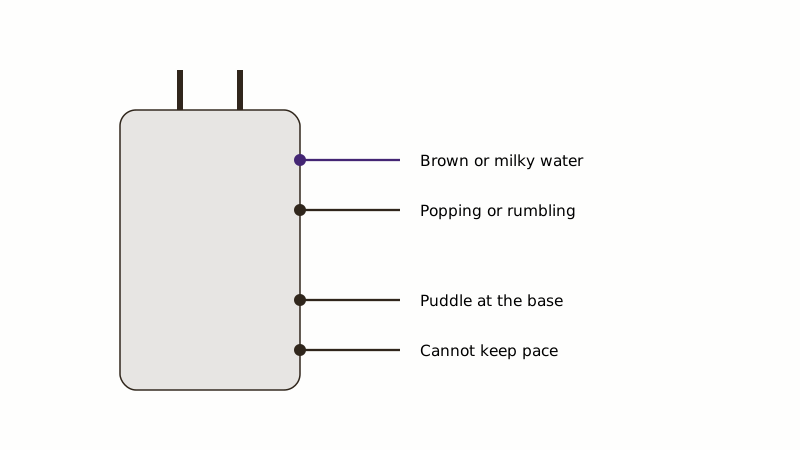
Hot water that runs brown or milky, a tank that pops and rumbles, a puddle at its foot, a heater that can no longer keep pace, and repair invoices that keep coming back. Any one of these in a tank older than a decade justifies pricing a replacement before the failure.
The costly sign is a wet floor. Tanks that fail often fail all at once, and water damage then costs more than the heater. If you spot moisture at the base, shut the cold inlet and the power or gas, and follow the steps for fixing a water heater leak.
When the hot water is simply gone, it is not always the tank. A tripped breaker or pilot problem is a cheaper fix, which is why no hot water is worth reading first.
Common questions
Does a warranty mean the heater will last that long?
No. A warranty is a promise about parts or the tank for a stated period, and it usually has conditions and exclusions. A six or ten year label is not a lifespan forecast, and a well-known brand is not automatically a trusted predictor either. Read the paper for what it covers, whether labor is included, and whether it is transferable, then plan around the lifespan figures above.
What happens during a changeout?
Draining the old tank comes first, then unhooking water, power or gas and the vent. The new unit goes in, gets connected, and is checked for leaks, with a test of the relief valve. Cities often attach a permit and inspection, and some homes need a fresh expansion tank. Ask what the price includes, including who takes the old heater away.
Is replacing early smarter than waiting for a failure?
Yes, and many people do. Replacing on your schedule lets you compare quotes, choose a size and time the work for a weekday. Waiting for a failure usually means rushing, paying for emergency timing and mopping up. If your tank is past ten and showing symptoms, planning is sensible.
Is rust in the hot water a sign of the tank dying?
It can be. Rust-colored hot water, with cold water running clear, often points at corrosion inside the tank, especially in a unit with a spent anode rod. If both hot and cold run rusty, the cause may be the supply pipes instead. Testing at several taps helps a plumber separate the two.