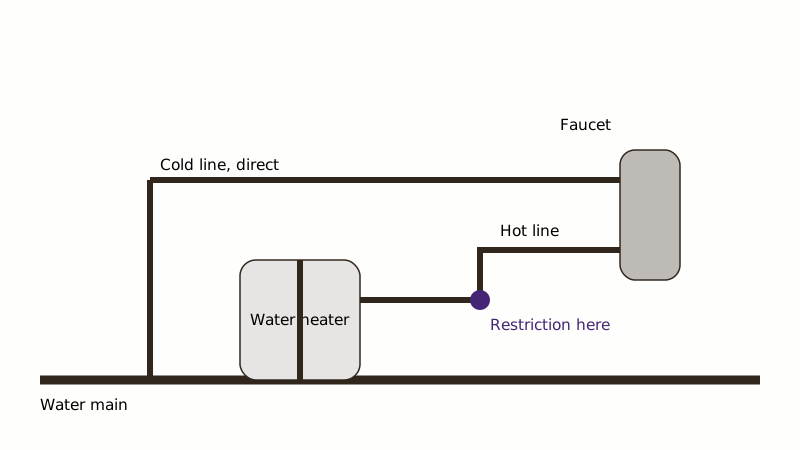
Strong cold, weak hot: that pairing rules out the street supply and points at the hot path, which means the tank or tankless unit, the valves beside it, or the line that delivers hot water to the faucet. Most causes cost little to fix, from a clogged aerator to scale in the tank. For sibling faults, browse water heater repair.
What makes only the hot water weak?
Because hot and cold only meet at the faucet. Cold water comes straight from the main. Hot water first passes through the heater and a separate set of pipes, so anything that narrows that route cuts the flow: scale, a half-closed valve, corroded steel pipe or a failing part inside the tank.
Treat that split as a clue. Weakness on both sides lives upstream of both, at the house shutoff, the regulator or the street, and why water pressure drops is the better read. Hot only? Stay here.
Notice also how many faucets are affected. A single weak hot tap is almost always a local fault. Weakness at every hot tap implicates the heater or the trunk hot line.
Which comparison tells you where the restriction sits?
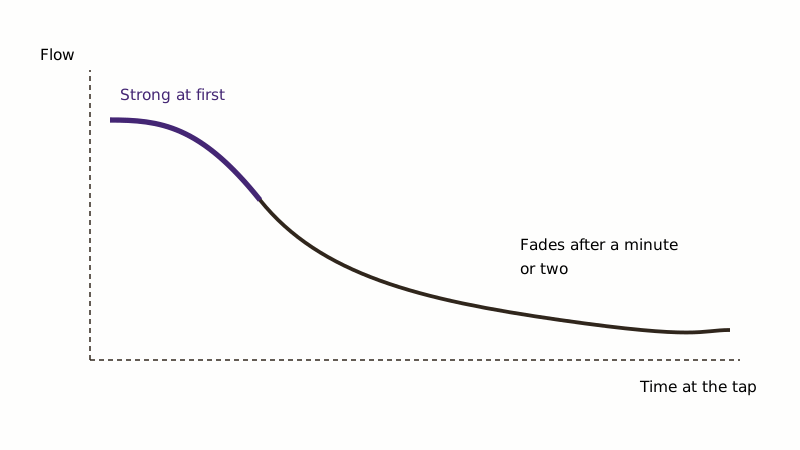
Compare, in order. First, one faucet against another. Second, hot against cold at the same faucet. Third, the first minute against the tenth. A hot tap that starts strong and fades hints at the heater's outlet or a collapsing part. One that is weak from the first second suggests a blockage.
Run this short sequence:
- Start with hot at the kitchen, move to the bathroom vanity, finish in the shower.
- Note which ones are weak and which are fine.
- Unscrew the aerator or showerhead on a weak tap and test again with it removed.
- At the heater, confirm both the cold-side and hot-side valves are turned all the way open.
- Check whether pressure improves after running the hot water for a minute.
Write the results down, because a plumber can use them to skip steps. A pattern like "all hot taps weak, cold fine, started two weeks ago" narrows things quickly.
Could a clogged aerator or cartridge be the cause?
Yes, and at a single weak tap it deserves first suspicion. Mineral grit gathers in the aerator screen and the mixing cartridge, and hot water, which drops scale faster, clogs them sooner. Take the aerator off, give it an hour in white vinegar, rinse, and screw it back.
If the shower is the only weak spot, unscrew the head and soak it the same way. Then look at the cartridge or mixing valve: a single-handle faucet that gives full cold and trickling hot likely has a tired cartridge or a hot port choked with grit.
An owner can manage these with a wrench, cloth padding on the finish and a little patience. Shut the fixture's stop valves first if it has them, and lay parts out in sequence.
Can scale inside the water heater reduce hot water pressure?
It can. When water is heated, hardness minerals settle out as scale, and the USGS says that scale builds up inside pipes and heating equipment, narrowing the passage and reducing flow. In a tank, sediment can also pile up and hinder flow. Ontario's 2025 report puts hardness at 91 to 177 ppm on average by source.
Tankless units are more exposed. The Department of Energy's guideline says scale builds inside a tankless unit's copper heat exchanger and can restrict flow, so manufacturers specify flushing, somewhere between two times a year and every third year. A tankless heater that delivers a thin hot stream is a strong candidate for descaling.
Flushing a tank is ordinary upkeep, and the notes on replacement timing explain when it helps and when an aged valve may drip afterward. Tankless owners should read about tankless service.
Can aging steel supply lines starve the hot side?
Often. Galvanized pipe corrodes inside and slowly narrows over the decades, and the hot line tends to go first because warmth speeds the chemistry. Homes built before copper became standard, which includes some older houses near downtown Ontario and the Euclid Avenue area, may still have galvanized sections.
The signs: pressure that declined slowly over years, brown water after the tap sits idle, and a weak flow that shows up at the farthest fixtures first. There is no home fix; the answer is replacing the corroded sections, which is plumbing work. See galvanized pipe replacement for what that involves.
Newer homes built with PEX or copper are less prone. In those, a hot-only pressure problem is much more likely to be the heater or a valve.
What if the water heater valves are the problem?
A valve only partly open throttles the entire hot side. Both valves at the heater should be wide open, and an old gate valve may have broken internally even though its handle turns. Replacing one is quick work, provided the supply is shut at the main.
Where a mixing or tempering valve sits on the hot line, it can clog too, and that one is easy to miss.
With a gas heater, leave the gas controls alone. Should you catch a gas odor, get outside first, then phone SoCalGas; the City of Montclair's phone list shows 1-800-427-2200 for suspected leaks.
Where does a homeowner's checklist end?
Ring someone when every hot tap is affected, when cleaning aerators and checking heater valves changes nothing, or when you see rusty water, leaks or a tank that has passed ten years. At that point you are into scale, corroded pipe or a failing component, and diagnosis needs tools and sometimes opening a wall.
In California, a contractor license stands behind any job priced at $1,000 or higher with materials, and behind anything permitted, which commonly covers heater replacement and repiping. Verify the license through CSLB, and request a quote that itemizes diagnosis, parts and labor.
To arrange a visit, open the quote page; the home page has the rest.
Common questions
Why does hot flow start well, then weaken?
A fade over a minute or two often means the heater's outlet or a scaled component restricts flow as the tank empties, or a tankless unit's heat exchanger is clogging. It can also mean a mixing valve is struggling. Note the timing and tell the plumber, since the pattern narrows the cause.
Would a softener cure weak hot water?
Not directly. Softeners reduce scale formation, so they can prevent future clogging, but they do not clear existing blockages. In this area, rules from the regional water agency limit new self-regenerating units, so check that before you plan one. Descaling the heater is usually the first move. See softener installation cost.
Is low hot water pressure dangerous?
Usually not, but it can signal problems that become costly. Scale strains the heater and shortens its life. Corroding pipes can eventually leak. If you also notice leaks, rusty water, a hot smell or pooling at the base of the heater, shut off the heater and ask a plumber to look quickly.
Does a new heater cure the problem?
Only when the heater itself is the cause. A new unit changes nothing if the restriction is in the pipes, a valve or a fixture, which is why testing first pays off. If the old heater has run most of its natural life, a swap and a pipe check can happen together.