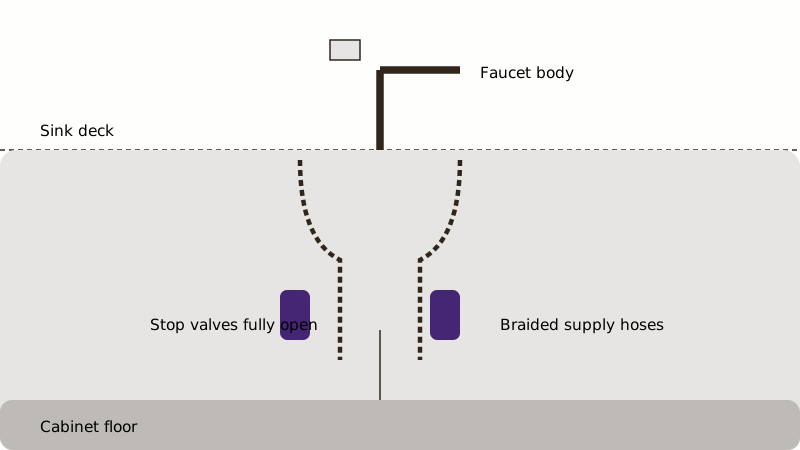
Open the bathroom sink beside the kitchen one and compare. If the bathroom runs normally while the kitchen dribbles, the trouble is local, and the usual suspects are a gummed-up aerator, a stop only partly open, a bent hose or a worn cartridge. When all taps run weak, the cause sits in the house supply or the street, which is a different job. Kitchen-only cases usually take under an hour. Other fixtures are covered under sink and faucet help pages.
Is it just this faucet or the whole house?
Test two other taps, hot and cold. A weak kitchen faucet with strong flow elsewhere is a fixture problem. Weak flow everywhere points toward the supply, a closed main, a faulty regulator or trouble at the utility. Weakness on hot alone suggests the heater or its line.
Sort your findings with this table.
| Observation | Where to look |
|---|---|
| Kitchen only, hot and cold alike | Aerator, cartridge, supply hoses, stops |
| Kitchen only, one temperature | That side's stop, hose or cartridge |
| Sprayer weak, spout normal | Sprayer hose, diverter, spray head screen |
| Every faucet | Main shutoff, regulator, utility supply |
| Hot weak throughout | Heater valves, hot line, sediment |
| Sudden drop after plumbing work | Loose debris, a valve left part closed |
House-wide trouble has its own pages: why pressure runs low and pressure that drops suddenly.
How do I descale a clogged aerator?
Unthread the aerator by hand, or use a wrench wrapped in cloth, pull out the screen and washer, brush away debris and leave everything in a bowl of plain vinegar for an hour. Rinse, reassemble and test. This fixes more low-flow complaints than any other step and costs next to nothing.
The aerator is the small mesh cap that blends air into the stream. Its fine screen traps sediment and mineral scale before anything else does. Ontario's 2025 water report puts hardness at 91 to 177 ppm on average, depending on source, so crusty white buildup is common around here.
Damaged screens and corroded parts are easy to replace with inexpensive aerators. Match the thread size, since some faucets hide a cache-style aerator inside the spout that needs a key. Flow limits are built in: the EPA treats 2.2 gallons per minute as the baseline for bathroom sink faucets and caps WaterSense labeled models at 1.5, so a modern faucet will never feel like an old one.
Run the faucet with the aerator off. A strong stream convicts the aerator; a weak one sends you deeper.
Might the stops, hoses or cartridge be choking the flow?
Possibly. Start with the valves under the sink, which should be open all the way. Then examine the braided supply hoses for kinks, and the cartridge inside the faucet for debris or wear. Any of them can starve one faucet while the other taps keep their normal flow.
Turn both stops all the way counterclockwise, gently, since old stops can be clogged or stiff. A hose bent during installation can restrict flow. To test, close the stops, point a disconnected hose into a bucket and crack the stop open. Strong water says the faucet itself is blocked.
Inside the faucet, grit, scale or a worn cartridge can narrow the passage. Plumbing work or a main shutoff can also shake debris loose so it lodges in the faucet. Close the water, remove the aerator and pull the cartridge so water can flush through the spout, then reinstall. Replace a scaled or worn cartridge with the identical model, and fixing a leaky faucet shows how to pull one.
What if only the pull-out sprayer is weak?
A weak sprayer with a normal spout usually has a clogged spray head screen, a kinked or scaled hose or a stuck diverter. Unscrew the head and clean its screen in vinegar, look along the hose beneath the sink for kinks and make sure the hose weight is not pinching it.
The diverter is a small valve that switches water between spout and sprayer, and when it sticks the sprayer starves. Some faucets let you remove it for cleaning, and the maker's manual shows how. An old hose can also swell or crack inside, and then it needs replacing.
Scale can also build inside the hose connection. If cleaning the head and diverter does not help, the hose or the faucet is next, and faucet installation cost gives a price guide.
What if every faucet in the house is weak?
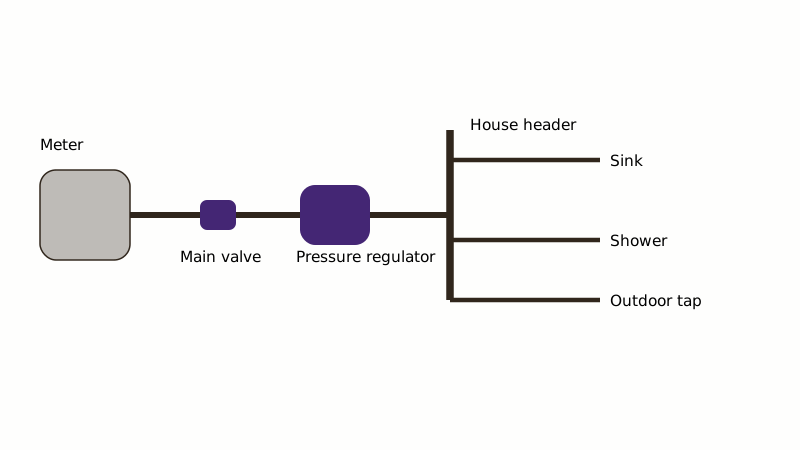
If every tap is weak, confirm that the main shutoff and meter valve are fully open, then check the regulator, if there is one. Inside a California house the pressure ceiling is 80 psi (Plumbing Code 608.2), and a failing regulator can drop it far below that.
Ontario's Municipal Utilities Company provides the city's water, so ring (909) 395-2600 if neighbors report the same problem. Outside the city the supplier can differ, and your water bill shows which one serves you. A planned repair or main break can lower pressure on a street.
Regulator basics: adjusting a pressure regulator. If hot water is the weak one, low hot water pressure covers the heater side. A whole-house problem that survives these checks deserves a gauge reading, and what a low-pressure visit involves describes the appointment.
What tells me a plumber has to handle this?
Reach out once you have cleaned the aerator and tested the stops but if several taps run low, a stop will not move or leaks, pipes look corroded, or the cause stays hidden. With a gauge, a plumber can read the pressure and trace a blockage or a failing regulator.
Never force a stuck stop valve; old ones snap and flood the cabinet. If one resists, close the main and ask a pro. Visits start at the quote page of Chaffey Pipe and Drain, and the price should be written down before work.
Common questions
What makes only the kitchen faucet weak?
Nearly always the cause is local to that faucet: aerator scale, a partly open stop, a pinched hose or a worn cartridge. Clean the aerator first, since it is the most common culprit, then check the stops and hoses under the sink.
How often does the aerator need cleaning?
Every few months in hard water, or whenever flow weakens or the spray splits. A vinegar soak removes scale without damaging most finishes. If the faucet has a delicate finish, check the maker's instructions, and avoid harsh tools on the screen.
Could the water heater explain weak hot water only?
Yes. Sediment in the tank, a valve at the heater that is part closed or a failing hot line can weaken hot flow while cold stays strong. Compare the two at one faucet, then check whether other hot taps are also weak.
Does low pressure mean a leak somewhere?
Sometimes. A supply line that leaks lowers pressure and raises the bill. If low pressure comes with a wet spot, a damp wall or a rising bill, close the house main and hunt for leaks, or call a plumber. Wet places where nothing should be wet deserve attention.
Is buying a new faucet the answer?
Only if the old faucet is the problem. A clogged or corroded faucet can be replaced, but if pressure is low everywhere a new one changes nothing. Do the aerator and stop valve checks first, and compare other taps before you buy.