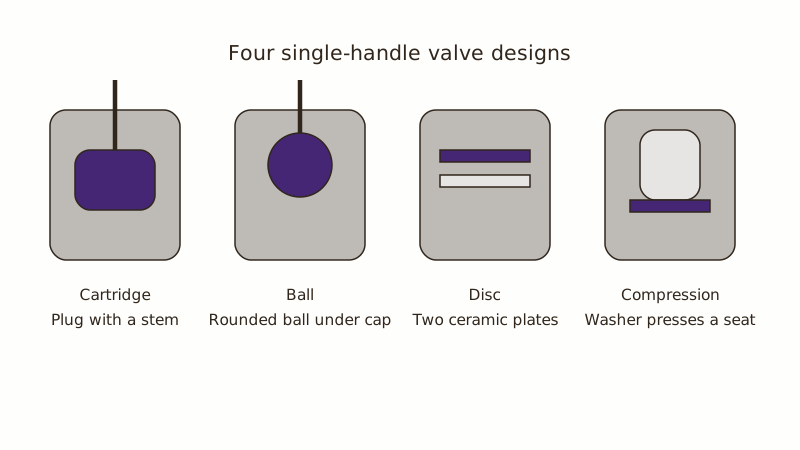
Most single-lever faucets are fixed by swapping the cartridge, or by replacing the springs and seats if it is a ball type. The valve is the only moving part behind the lever, so one new part usually ends the drip. This page belongs to the group of faucet, sink, shower and disposal repairs, and begins by sorting the four mechanisms.
Do not buy a part before you have looked. Single-handle faucets look alike from outside and differ completely inside, and a wrong cartridge will not fit or will leak again within days.
Which kind of single-handle faucet is it?
Four designs exist. A cartridge faucet has a small plug with a stem that the lever moves. A ball faucet has a rounded metal or plastic ball under a cap, often on kitchen faucets. A disc faucet carries two ceramic plates in a wide cylinder. A compression-style single handle is rarer. Disassembly shows which one you have.
Clues from outside: a ball faucet usually has a rounded cap with a knurled ring under the lever. A disc faucet tends to have a wide, shorter body and a smooth cylinder cap. A cartridge faucet lets the lever pivot and lift. Take a photo as you go. Take the spent part to a supply store, or read the model name on the faucet body or in the cabinet paperwork. Older homes near the Euclid Avenue historic district may still have older ball or washer designs, while newer builds in Ontario Ranch and The Preserve usually have cartridges or discs.
How do I get the lever off?
Shut the stops below the basin and open the spout to relieve pressure, then hunt for the set screw: look for a small hole or hidden screw under a cap on the lever. Pry off the cap, loosen the screw with a hex key or small screwdriver, lift the lever off, and unscrew the decorative cap and collar beneath it.
Seal the drain with a rag, since screws are small and a dropped one disappears. Keep every part in order on a towel so reassembly is simple. A stubborn cap can be turned with pliers over a cloth, which spares the finish. Scale often cements these parts in place. The city's 2025 water quality figures show hardness averaging 91 to 177 ppm depending on the source, and a splash of vinegar softens the crust.
What do I replace in each type?
For a cartridge faucet, release the clip or nut and lift the cartridge, then drop in an exact match with the same alignment. A ball faucet gets new springs and rubber seats plus body O-rings. A disc faucet gets a new cylinder or seals, and its inlet ports are cleaned. A kit with the matching parts is the easiest buy.
Rubber O-rings on the spout swivel are a separate leak point: if moisture shows at the spout's foot instead of its tip, roll off the old O-rings, match them, grease lightly and slide on new ones. For a pull-out kitchen spray, the hose connections under the sink can also drip, tightened by hand with a wrench. Ceramic discs are tough, so if a disc faucet drips, grit between the plates is likelier than wear: flush and clean before replacing.
What does each wet spot point to?
Spout drips mean a worn cartridge, ball seat or disc. Moisture at the spout's foot means tired swivel O-rings. Water at the lever means loose packing or a worn cap seal. A drip that starts only when the lever is in one position suggests worn seats or a cracked cartridge.
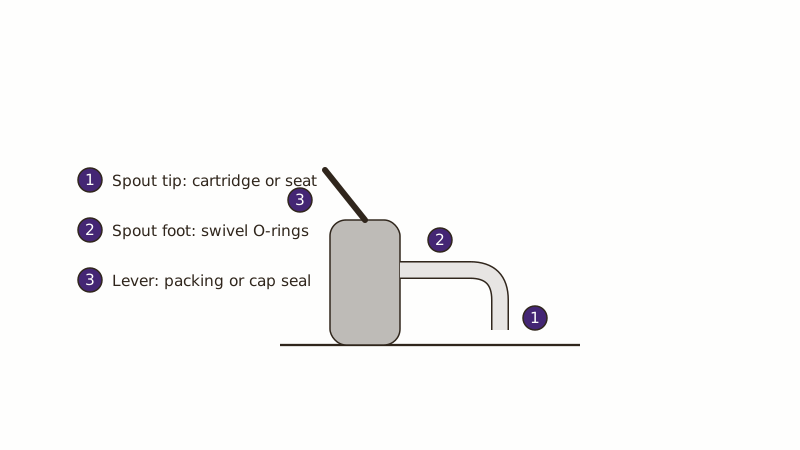
Matching the leak to the part saves a second visit. It also bears on the water bill, given that the EPA counts above 9,300 gallons of annual leakage in a typical household. The arithmetic is in a drip and your bill, and the older design with two knobs is covered in fixing a two-handle faucet. Showers use the same cartridge principle, and a dripping shower faucet shows the differences.
What if the new part did not stop it?
Check that the part matches and sits fully, that seals are seated flat and not pinched, that the retaining clip is in place, and that the lever is not forcing it. If it still leaks, the body or seat may be corroded and the faucet is better replaced than rebuilt.
If you replace it, the work needs matching supply lines and a compatible sink hole. What installing a faucet costs outlines how a plumber prices that job, and low flow at a kitchen faucet covers the aerator and cartridge issues that cause weak flow after repairs. Valves under the sink that refuse to close call for a plumber instead of adding force. A broader overview, dripping faucet basics, fits every type. A visit is requested on the quote form, and the home page points to other help.
Common questions
How much of an hour does it use?
A cartridge swap on a kitchen or bath faucet typically takes 20 to 45 minutes with supply closed and the correct part at hand. A ball faucet takes a little longer because of the springs and seats. Delays come from stuck parts, a missing hex key or finding a matching cartridge.
What belongs in a plumber's quote for this?
The part price, a test of the stops and supply lines, and an honest opinion on repairing versus replacing the whole faucet. Have the figure written down. In California, permit work and larger jobs fall under contractor license rules, so check that the quote shows a license number.
Is anyone required at home?
Doing it yourself, you are home by definition. For a plumber visit, an adult should point to the faucet, confirm the leak and test the faucet afterward. Empty the cabinet below so the shutoffs are in easy reach and nothing gets splashed.