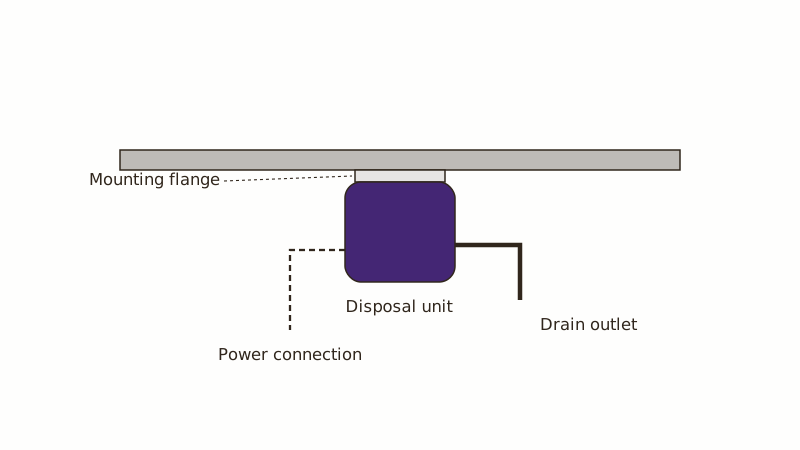
A garbage disposal installation service swaps or fits the grinder under your kitchen sink. A local plumber visits, disconnects and carries off the old unit if there is one, fixes the new grinder to the sink flange, joins the drain and dishwasher line, completes the power connection and checks for leaks. This Old House puts professional installation at about one to four hours. This page belongs with faucets, sinks, showers and disposals and describes what you are paying for.
What happens during a disposal removal and installation visit?
The plumber shuts off the power and water, unplugs or disconnects the old unit, unmounts it from the sink flange, and removes it. The new disposal gets mounted to the flange with a gasket and mounting ring, connected to the drain trap and the dishwasher hose, then wired or plugged in. The last steps are a leak test and a run test.
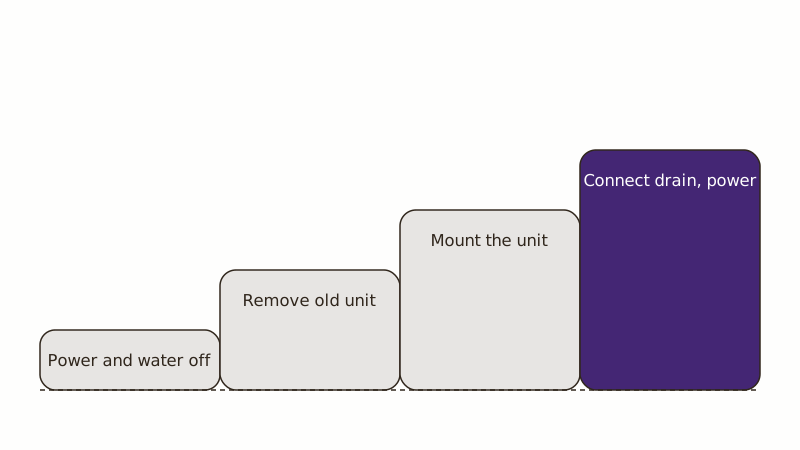
If there was no disposal before, the job is bigger: a sink flange may need replacing, a switch or outlet may need adding, and the dishwasher drain may need a knockout plug removed inside the new unit. The plumber should tell you about those steps before starting, because they change the time and the price. At the end, have them show you the switch and where the reset button is.
Should I install it myself after watching a video?
Many people do, and videos show the steps clearly: mount the flange, attach the unit, connect the drain, plug it in. The risks are a leaking flange or drain, a misconnected dishwasher line, and the wiring on a hardwired unit. If the plumbing is old or the shutoffs do not close, a video will not tell you what is wrong.
Be realistic about your skills. If wiring or a drain that will not line up worries you, hire a plumber and keep the unit price in your budget. For a first-time install in a sink that never had one, expect more work than a swap. Hiring someone also gives you a person to call if it leaks the next day.
To book, ask for quotes and the figure arrives in writing before work. Other services appear on the home page.
Which disposal should be installed?
Choose by motor size, feed type and how the house uses the sink. Larger motors cost more and handle tougher scraps, while small ones cost less. Continuous-feed units grind while the switch is on; batch-feed units only run once the stopper is seated. Brands such as Moen and GE each publish their own installation instructions, and a good installer follows them.
For a household that cooks often, a mid-range motor is a common middle path, though that is judgment, not a rule. Single and double bowl sinks both work, but the drain layout differs, so the plumber should see the setup. This Old House gives price bands by motor size and feed type, which you can see on our page on what a faucet or disposal costs. The written quote from a local plumber sets the real price.
Is the old disposal worth repairing instead?
Sometimes. This Old House says repairing a disposal whose motor still works costs $50 to $400, but that replacement is usually cheaper than repair when the motor is dead, and units last about 10 years. A jammed unit can sometimes be freed from the bottom socket, and many have a reset button; follow the maker's manual. See unclogging a garbage disposal for those steps.
Leaks from the body, humming without turning, or repeated breaker trips usually mean replacement. A leak at the flange or a worn gasket may need only the mounting parts. Ask the plumber to write up both options so repair and replacement can be compared.
Does the electrical part need an electrician?
Often it does, for first-time installs. This Old House notes that the biggest part of a first-time disposal job is often the electrical work, and that continuous-feed models typically need an electrician, who charges about $50 to $120 an hour. A plug-in unit that connects to an existing outlet under the sink avoids most of that.
Hardwired units connect straight to the circuit, so a wall switch is needed; a button or air-switch model puts a small button on the counter. If wiring is involved, ask whether the plumber handles it or brings an electrician, and whether a permit applies. For permit questions, the City of Ontario Building office, at (909) 395-2023, can say what is required. The state wants a contractor license on work of $1,000 or more and on anything permitted.
How do I get the kitchen ready?
Clear out the cabinet under the sink so there is room to work. Find the sink's shutoff valves and the power switch or breaker for the disposal. If you have bought the unit, keep the box and instructions; if the plumber supplies it, confirm the model. Tell them if the old unit leaks, jams or trips the breaker, since that helps with the diagnosis.
Plan for the sink to be out of use for part of a morning or afternoon. Run the dishwasher before the visit so you do not need it, and clear the counter near the sink. Take a quick look at the dishwasher drain hose, since a kinked or old hose is easy to replace during the visit. Mention a slow drain at the sink too: a disposal will not fix a clogged line.
Common questions
How much of the day does the job take?
This Old House says professional installation runs about one to four hours. A like-for-like swap sits at the short end, while a first-time installation with a switch, new flange or dishwasher connection runs longer. Ask for an estimate along with the quote.
What should be spelled out in the quote?
Whether the price covers the unit, mounting parts, a cord or wiring, the dishwasher connection and removal of the old disposal. Also who does the electrical work, whether a permit applies, and the license number to look up with the state. Get all of it written.
Should someone stay in the house?
At the start and the end, yes. The plumber needs the sink and a power switch, and you want to watch the disposal run before they leave. Test it with water flowing, peek under the sink for drips, and ask about first-use habits such as running cold water while grinding.
Can a disposal be added to any kitchen sink?
Most kitchen sinks with a standard drain opening can take one, but the cabinet space, plumbing layout and electrical access matter. Some specialty sinks or very shallow cabinets are a poor fit. The plumber can check on the visit, and a double bowl or a sink with a trap close to the wall may need extra fittings.
Does a disposal need special care in hard water areas?
Run cold water while grinding and flush for a bit afterward. Hard water can leave mineral scale in drains over time, so a slow sink should be looked at early. If the sink drains slowly with or without the disposal, see a kitchen sink draining very slowly.