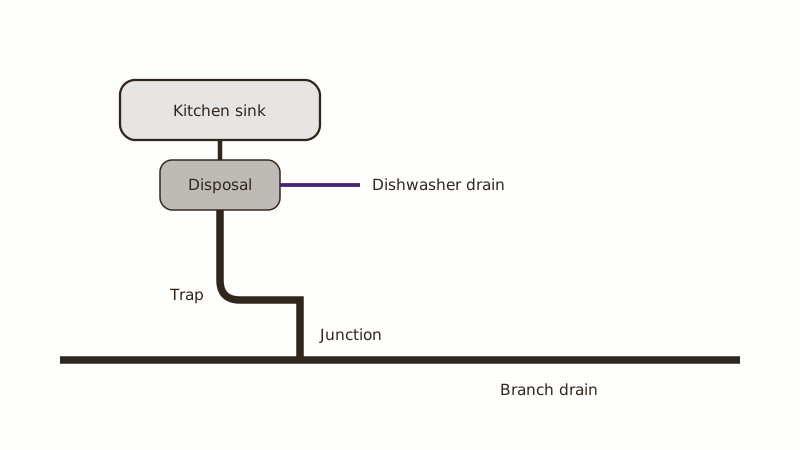
Slow kitchen drains are rarely mysterious. Most often the culprit is cooled cooking fat gripping the pipe wall a short distance past the sink, with coffee grounds and food bits stuck to it. The fix is usually a trap cleaning or a plunger, not a major job. Wider background is under drain cleaning and clogs.
What is really going on inside a sluggish kitchen drain?
Grease leaves a coating along the pipe's interior. Fat that was liquid in the pan solidifies the moment it meets cold pipe, then catches soap scum and crumbs. The opening shrinks a little with each dinner, so the sink empties more slowly long before it refuses to drain at all.
Bathroom plumbing fails differently. A shower drain mostly collects hair bound with soap, while kitchen lines carry grease, which is why the kitchen is the one that slows first and fastest.
Pipe age plays a part. Houses around downtown Ontario and the Euclid Avenue area can still have old steel or cast iron waste lines whose rough interiors collect debris faster than modern plastic does. Newer homes in Ontario Ranch are often plumbed with smooth plastic, which usually clogs only when something large lodges.
What can you try, starting with the least effort?
Begin with a hot rinse and a few drops of detergent, move to a plunger, then open the trap, then use a small hand auger. Stop whenever the sink runs freely. If you reach the auger and nothing changes, the clog is past what home tools reach, and a plumber with a machine is the next step.
| Step | What you do | Works for |
|---|---|---|
| 1 | Hot rinse with a little detergent, twice | Light grease film |
| 2 | Cup plunger, other bowl blocked | Plugs near the sink |
| 3 | Open and rinse the curved trap | Food packed at the bend |
| 4 | Short hand-cranked cable pushed into the wall pipe | Clogs a few feet back |
| 5 | Stop; ask for a motorized cable or camera | Deeper or repeating clogs |
On step 2, wet a rag and jam it in the second bowl's drain, and cover the dishwasher hose connection if there is one. Pressure needs one place to go. Twenty firm strokes are plenty.
On step 3, set a bucket down first, then undo the two coupling nuts with your fingers, and empty the curved trap into the bucket. Rinse it, inspect the washers, and screw it back together firmly.
Is baking soda and vinegar worth a try?
On a mild film, a little. The fizz can nudge light residue loose, but a thick grease plug will outlast it, and a wad of food will not care. Use it as a tune-up for a drain just starting to slow, never as the cure for one that crawls.
Store-bought chemical openers raise other concerns. Burns to skin and eyes are the first worry, harm to aging pipe is the second, and combining products is a third. A treatment that fails also also leaves harsh liquid pooled at the trap for the next person to meet, quite possibly you. Mechanical tools are gentler. After any chemical, warn the plumber first.
Additional kitchen-safe ideas live in the home remedies article.
Might the disposal be behind it?
Yes, particularly when the dishwasher hose joins the disposal. A chamber packed with ground food drains slowly, and the dishwasher can back up with it. Cut power at the wall switch before checking anything, and use tongs rather than fingers if you need to remove an object.
If the dishwasher was added after the disposal was installed, confirm the knockout plug in the disposal's dishwasher inlet was punched out, because a plugged inlet leaves the dishwasher draining sluggishly. Run cold water with the disposal on for a minute to flush it afterward. A disposal that hums without turning can often be freed with the hex socket beneath it; its manual shows where.
There is a full walkthrough in unclogging a disposal drain.
How do you tell a kitchen-only clog from a bigger sewer problem?
Count the affected fixtures. Start by counting fixtures. If only the kitchen sink lags, the clog is local. Gurgling in several rooms, a toilet that glugs whenever the sink empties, or sewage rising at the lowest floor drain or tub all point farther along, toward the main drain.
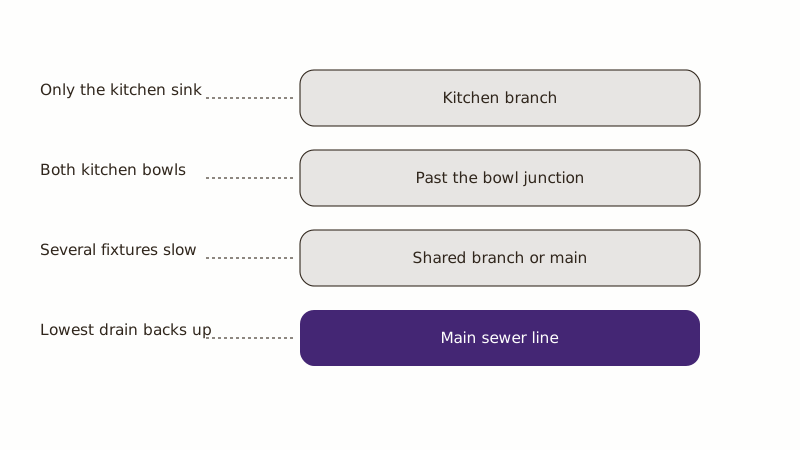
| What you see | Likely location | Who handles it |
|---|---|---|
| Kitchen sink alone is slow | Kitchen branch | You, or a plumber |
| Both kitchen bowls slow, others fine | Past the bowl junction | A plumber with a cable |
| Several fixtures slow or gurgling | Shared branch or main line | A plumber with a machine or camera |
| Backup at the lowest drain, sewage odor | Main sewer line | A plumber first; the city if neighbors are affected |
In Ontario, the city's utility handles sewer collection. If your neighbors also have trouble, report it to Ontario Municipal Utilities Company at (909) 395-2600. For the stretch from your foundation to the street, have a plumber scope it and explain who is responsible at your address.
At what point do you stop and call someone?
When the plunger and the cleaned trap achieve nothing, when the blockage reappears in a matter of days, when several fixtures are involved, or when a sewage odor appears. A plumber can use a motorized cable, a camera or high-pressure water to clear the line, and can show you whether the pipe itself is damaged.
Repeat clogs in an older house sometimes mean a sagging or cracked section, where debris keeps catching. Cabling again will only buy a few weeks. A camera view settles that.
Under California rules a permitted job needs a contractor license, and the threshold is $1,000 for anything else once materials are counted. Ask for the license details, plus a quote naming the cleaning method. The quote page opens the process, with the home page behind it. For budgeting, read what unclogging a sink costs.
What keeps the drain open afterward?
Daily habits matter most. Cool pan grease in a can and bin it, wipe oily plates with paper before washing them, set a fine mesh strainer over the drain, and rinse with very hot water after the oiliest meals. Skip fibrous scraps in the disposal and run cold water while it grinds.
Monthly, flush with hot water and a touch of detergent, add baking soda and another hot rinse, and take the strainer out for washing. Where an older house keeps clogging, a yearly professional cleaning can head off a backup at the worst moment, such as holiday cooking.
Common questions
Why would just one bowl of a double sink be slow?
The blockage lies between that bowl's tailpiece and the spot where the two drains meet. Remove the slow side's trap arm, clear the tailpiece and check the strainer. If both sides slow once you plunge, the obstruction is further along. One slow bowl is encouraging, because the problem is close and reachable.
Can you plunge a sink that has a disposal?
Yes. Use a cup plunger, seal off the dishwasher line, plug the other bowl and add enough water that the plunger cup sits under the surface. Avoid plunging right after a chemical cleaner, because splashes are hazardous. If the disposal is jammed and humming, turn it off at the wall switch before doing anything else.
Does a slow sink mean the whole drain line needs replacing?
Rarely. Most slow sinks respond to plunging, a rinsed trap or a hand snake. Replacement enters the conversation once a camera reveals a cracked, corroded or sagging pipe. When clogs return to the same spot, have the line inspected on camera before anything is replaced, and ask to view the recording.
What if the sink will not drain at all?
Stop adding water, bail what is there into a bucket and work through the steps above. If it stays full, or water appears in another fixture, ring a plumber, especially with a sewage smell. A total backup can overflow without much warning, so keep towels and a bucket close.