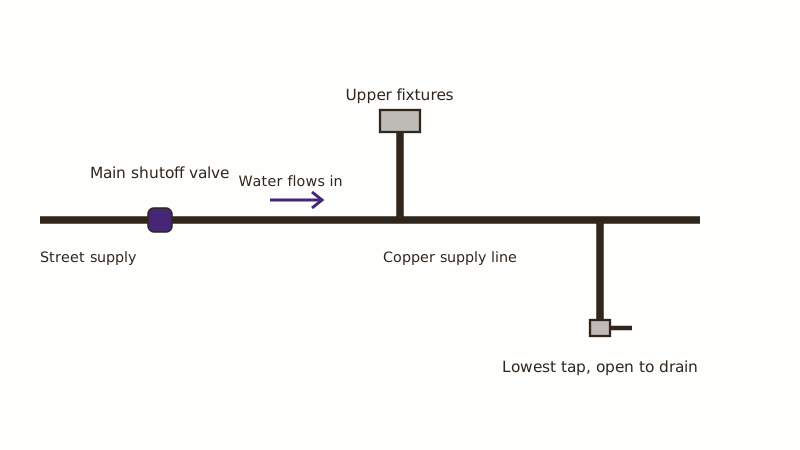
Water is spraying or weeping from a copper line, and the first minute matters more than the repair. Run to the main valve and turn it off, then let the line empty out of a low faucet. Looking at the damage comes after that. The page keeps to that order, then sorts fixes by what is safe for you to try. The wider leak picture is under help with leaks, and the Chaffey Pipe and Drain home page has the rest of our services.
What should you do the moment copper starts to leak?
Shut the main valve, let pressure out through the lowest tap, and kill the power wherever water has crept toward sockets, appliances or wiring. After that, set out a bucket, move belongings and photograph everything for your insurer. Wet hands and electrical panels never mix.
Not sure where the main is? Check beside the meter, at the house frontage, or on an outside wall by the water heater. Find it today, not mid-flood. A leak you can't stop is an emergency, and urgent burst pipe help explains how those calls work.
Mop and towel the area dry. Every kind of copper repair works better on a dry surface, and puddles hide how far the damage runs. If a ceiling has already been hit, tell your insurer early.
Is it a pinhole, a joint or a split?
Inspect it once it's dry. A fine jet or green crust at a single point says pinhole. Seepage at a connection says a failed solder joint or fitting. A long slit or a bulge, often from freezing or excess pressure, says split. The label decides the repair.
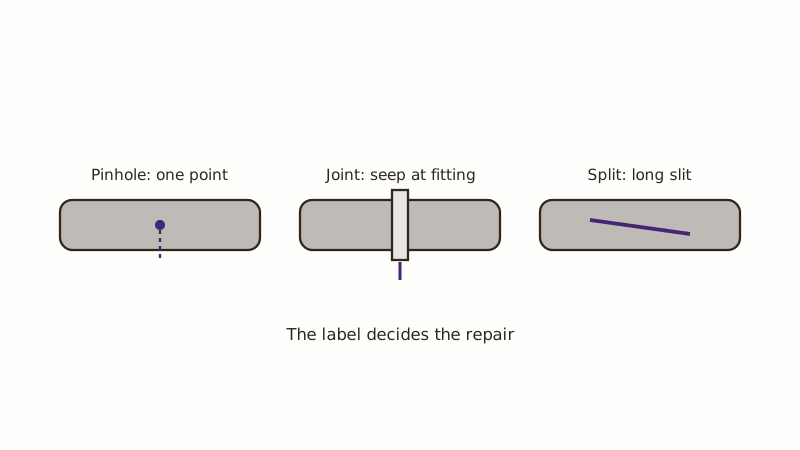
Pinholes start inside, where corrosion thins the wall. One often means others are developing, so pinhole leaks in copper covers the point at which patching stops making sense. Water chemistry can play a part, and so can the pipe's own history.
A local note: the 2025 Ontario water report puts hardness at 91 to 177 ppm on average, by source. Hardness mostly shows up as scale, not pinholes, so don't assume a link in your house. An inspection settles it.
What stopgap repairs are worth trying?
A rubber-backed clamp, self-fusing silicone wrap or epoxy putty can quiet a small leak until help arrives. Treat each as a bridge. Sand the copper bright, follow the label, and line up a real repair. What holds today can let go under pressure next week.
We cover them in pipe leak sealants, including where they fail. A patch is no reason to forget the leak: a drip you can't see inside a wall can wet insulation and drywall for weeks without showing.
Plastic lines take different fittings and glues, so advice for copper won't carry over. For those, read leaks in plastic pipe.
What are the lasting repairs for a copper pipe?
Three options hold up. Push-fit and compression couplings bridge a cut without any torch. A soldered coupling is the classic route and needs skill. Swapping a whole section, or the whole run, wins when corrosion runs the length of the pipe, not just one spot.
Push-fit parts suit cramped spots where a torch is risky, provided the pipe is clean, square-cut and dry. Soldering demands dry pipe, flux, solder rated lead-free for drinking water, and a fire-smart setup. Flame near framing, insulation or old paper is how repairs become house fires, so keep an extinguisher and a wet rag within reach.
Beginners shouldn't treat any of these as a casual weekend job. A poorly made joint can fail months on, behind drywall, where it does the most harm. When confidence is low, hire it out.
Where does DIY stop on a copper leak?
Pass on leaks inside walls or ceilings, anything near the water heater or gas lines, anything beneath a concrete slab, repeat pinholes, and soldering near flammable material. Skip permit jobs as well, and ask the city Building office before you start any repair that might need one.
Gas piping is never a DIY matter. Rotten-egg smell? Everyone out of the house. Once outside, call SoCalGas at 1-800-427-2200, and add a 911 call if someone is actually in danger. That outranks any water leak.
A suspected slab leak or a hidden leak is a detection job before it is a repair job. Start with slab leak detection and repair or, for a mystery bill, high bills with no visible leak. A tired system overall points to repiping. The city's Building office, (909) 395-2023, answers permit questions.
Common questions
What's the likely time on site?
A coupling swap on an open, reachable pipe can wrap up within two hours of draining. Leaks inside walls or behind fixtures take longer, since the wall must be opened, repaired, tested and patched. No honest time estimate exists until the leak has been seen in place.
Which questions suit a leak call?
Find out if the callout charge is credited, whether wall opening and patching are in the quote, how the repair will be pressure-tested and how extra damage would be handled. Request the scope on paper. Flag urgency so after-hours work is priced in.
Should I be there while the pipe is fixed?
Yes, so access, the shutoff location and the scope can be handled in person. Before the visit, clear the room around the leak, count on dry taps for several hours, and keep children and animals out of the way of the work.
Can I use a leak sealant on copper pipe?
For a small leak, as a temporary measure, yes. Products vary, so read the label for pipe material, pressure rating and cure time. A sealant isn't a permanent fix, and it can make a later repair harder if it leaves residue on the metal. Book a proper repair soon.
Why bother fixing a tiny drip?
More than people expect. Federal guidance from the EPA says ordinary household leaks waste thousands of gallons yearly. A pinhole under pressure keeps adding to that around the clock. That's why even a slow drip deserves a quick shutoff and repair, not a wait-and-see approach.