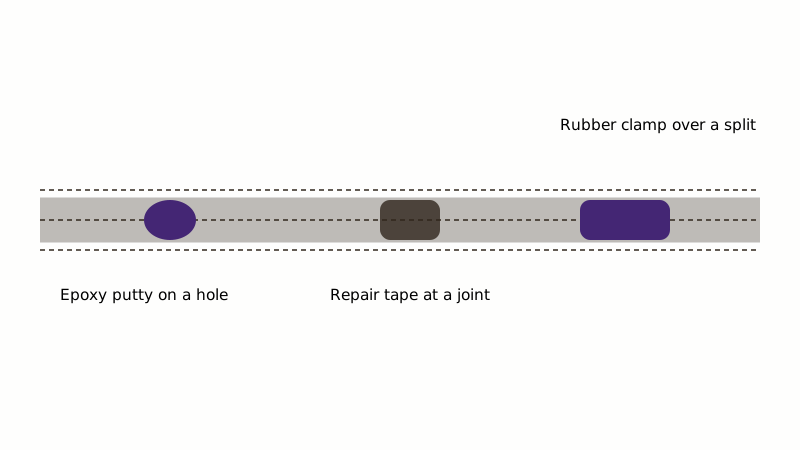
Treat a pipe sealant as a bandage, not surgery. Epoxy putty, wrap-on tape and clamps can hold back a pinhole or a sweating joint long enough to protect the house, and some patches hold for days or even weeks. None restores the pipe itself. Oatey's own guide calls its repair putty a temporary repair until a plumber can finish the job, and everything below assumes that. The broader picture is under help with leaks and burst pipes.
Does leak sealant actually fix a water pipe?
No, not permanently. A sealant buys time for a small leak while a proper repair is arranged. Oatey describes its Fix-It Stick as acting only as a temporary repair until a plumber completes the work. Water pressure pushes on the patch from inside, and over time the patch can crack, lift off or let go.
That is why a sealant suits only one situation: a small leak, water shut off or about to be, and a proper repair on its way. It is not a way to ignore a corroding pipe.
Failure has a simple cause. A pressurized pipe leans on the patch every minute of the day, while temperature swings, vibration and pipe movement keep working at it. Lasting repairs remove the bad section and join new pipe with proper fittings.
Which sealant goes on which leak?
Epoxy putty suits small holes in metal and plastic pipe, repair tape wraps a weeping joint or crack, and a rubber-lined clamp squeezes shut around a split. Match the product to the pipe's material and size, and read its label for water use and temperature limits.
| Product | Best for | Limits |
|---|---|---|
| Epoxy putty stick | Pinholes, hairline cracks on PVC, CPVC, ABS and metal | Needs a clean, dry surface, temporary on pressure |
| Self-fusing repair tape | Weeping joints, wrapping small splits | Needs tight overlap, not for high pressure |
| Repair clamp or sleeve | Split sections of pipe | Pipe must be round and clean |
| Slip coupling or push-fit repair | Cutting out a bad section | Needs the pipe cut and a proper fitting |
| PVC cement and primer | New joints in PVC | Used when replacing, not sealing in place |
Oatey's guide names PVC, CPVC, wood, metals and ABS among the surfaces its putty is meant for. Read the label of whatever you buy for pipe types, water temperature and whether it is rated for drinking water lines.
Liquid sealants poured into a plumbing system to seal leaks from the inside are a different category. They are no substitute for finding the leak, results vary, and a plumber should weigh in before you add one to household plumbing.
How do I apply epoxy putty to a leaking pipe?
Close the water off and drain the pipe, clean and sand the spot, knead the putty to one even color, press it over the hole and slightly past it, smooth it and let it cure. Oatey says its putty begins to set in about 20 minutes and reaches full strength at 24 hours.
Take the steps in order.
- Close the supply to the line and run a faucet to empty it. For slow leaks, Oatey's guide says the water should be off and drained.
- Remove dirt and oil, then sand the spot so the putty grips.
- Put on gloves and knead the putty for roughly a minute until it is uniform in color.
- Move quickly. The guide advises working within a few minutes of mixing, since putty left in the air hardens and turns brittle.
- Push it over the leak and beyond its edges, fill every hole and crack and smooth the rim.
- Wait out the full cure before restoring water, then keep watching the spot.
If water keeps pouring out of the leak,
Where do sealants fail completely?
Sealant is no help on a burst pipe, a long crack, a leak behind drywall, a corroded section where the pipe wall is thin, a failing threaded fitting or a joint that keeps shifting. It should never go on a gas line. Each of those needs the damaged section replaced.
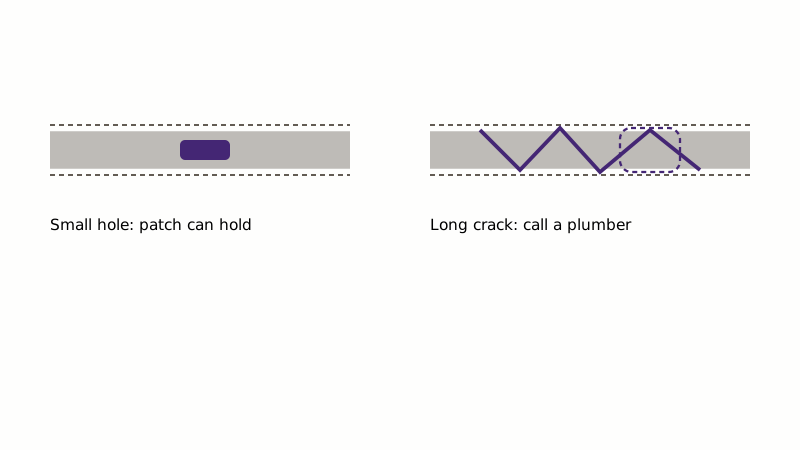
Pinholes in older copper can signal a pipe wearing out along its whole run. Patch one and the others remain, with new ones possible nearby. Copper pipe pinhole leaks shows how to separate a one-off from a pattern.
Ontario's 2025 water report puts hardness at 91 to 177 ppm on average, depending on source, and scale and corrosion can wear pipes over time. If you have patched more than one leak in a year, consider repiping instead of adding another patch.
Pipe-specific guides: repairing a leaking copper pipe, leaking PVC joint repair and stopping leaks in plastic pipe.
What is the very first step on discovering a leak?
Close the closest valve you can reach, or the house main, and open a tap to release line pressure. Slip a bucket beneath the drip, clear belongings away, take photos of the damage and dry the area. After that, decide whether this is a patch or a plumber's job.
Speed matters. A leak under line pressure can do far more damage than a dripping faucet. If the leak is large, spraying or inside a wall, keep the water off and handle it as an emergency; burst pipe emergency help covers that.
Never rely on a patch while the water stays on. Keep the supply closed until the cure time is up, and check the repair repeatedly over the first days.
When does a sealed leak need a plumber?
A plumber is needed when the leak is buried in drywall, a ceiling or a slab, a length of pipe is eaten away or cracked, the shutoff valve is stuck, the patch weeps again, water has reached more than one room or the pipe carries gas. A plumber can remove the damaged section and join new pipe with proper fittings.
Hidden leaks are covered in leak detection pricing. On bigger repairs, learn who is doing the work and the price before you agree.
Visits are requested on the quote page at Chaffey Pipe and Drain; someone local arrives, and you should have the price in writing.
Common questions
How long does pipe leak epoxy last?
It varies with the product, the pipe, the line pressure and the application. Oatey calls its putty a temporary repair and says it hits full strength after 24 hours of cure. Treat any patch as short term, and schedule the permanent repair promptly.
Can I use sealant on a pipe that is under pressure?
Better not. Oatey's guide says the water should be shut off and drained before starting on slow leaks. Putty applied to a wet, pressurized pipe bonds poorly and tends to fail. For active leaks, close the valve, drain the line, then patch.
Can I put sealant on a drinking water line?
Only when the product says so. Look on the label for potable water use and temperature limits before touching a supply pipe. If drinking water is not mentioned, pick something else, such as a clamp rated for potable water, or ask a plumber.
Will sealant work on a pinhole in copper?
Sometimes, as a stopgap, since epoxy putty can grip metal pipe when the spot is clean and dry. A pinhole usually means the wall is thinning, so expect more. Replacing that section, or repiping when there are several, is the lasting answer.
Is a permit involved in fixing a leaking pipe?
It depends on the work. A small repair may not need one, while larger work might, and rules vary by city. If the job goes beyond a patch, ask the City of Ontario Building counter, (909) 395-2023. A permit also brings California's contractor license rule into play, so ask a plumber.