A PVC joint that drips is telling you the glued bond failed, the pipe moved, or the part cracked. Tape and putty buy a day at best. A repair that lasts replaces the damaged piece and glues the new one in with the right primer and cement. On an accessible drain line, many owners can manage it. Pressurized supply lines, hidden leaks and anything near a main call for more care. It falls under leaks and burst pipes. Rather have a plumber do it? A quote request sets that up.
Why does a PVC joint start to leak?
Four causes cover most cases: a bond that never fully set, movement from settling or water hammer, a crack from impact, heat or overtightening, and age. Dried cement bonds the pipe and fitting into one piece, so a leak at the hub usually means the weld was poor from the start or has since been stressed.
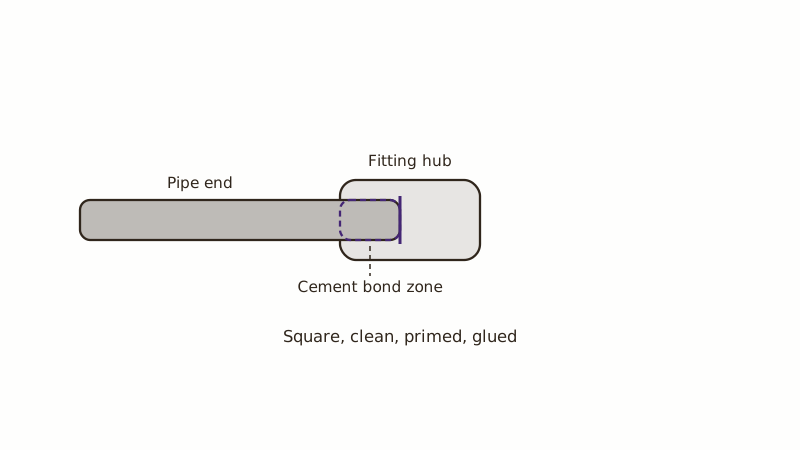
Oatey, a cement maker, says the bond depends on cut ends that are square, deburred and clean, a proper fit, primer, a thin but even coat of cement, a quarter turn on assembly and a hold of about 30 seconds. Skip any of those and the joint can fail years later. Puddled cement weakens a joint too. Corrosion is not the issue with PVC itself, though metal fittings next to it can corrode.
How can you tell where the leak really is?
Wipe the joint dry, then see where moisture first reappears. Water creeps along a pipe, so what drips here may have started farther along. Wrap a dry tissue around the suspect fitting and see if it is damp ten minutes later. A pressure line drips constantly. A drain line leaks only while water flows through it.
If no source shows up but the water bill is high, or the meter turns with everything off, the leak may be hidden. EPA's two-hour meter check is a useful test. Hidden, buried or slab leaks are found with specialist tools, as described under leak detection costs. Water behind drywall or beneath concrete should be diagnosed, never guessed at.
Do tape, epoxy or a clamp really fix a weeping PVC joint?
As a stopgap, yes. A rubber repair clamp, epoxy putty or a wrap can slow a seep until the real repair happens. They are not a fix for a pressurized joint that is passing real water, and they can fail without warning. Treat them as temporary and plan the real repair.
Compression repair couplings work on a damaged straight run without glue, and some owners prefer them for accessible lines. A glued repair is the long-term standard for drains. Whichever you pick, shut off the water and let the pipe dry first, because cement will not set on a wet surface. Where sealants help, and where they do not, is explained at leak sealants for water pipes.
How is a leaking PVC joint properly repaired?
The sequence: water off, line drained, damaged section cut out with square ends, edges deburred and wiped clean, new coupling or fittings test-fitted dry, then primer and cement. Oatey says to apply primer inside the hub, on the pipe end, and again in the hub, then cement within five minutes or re-prime.
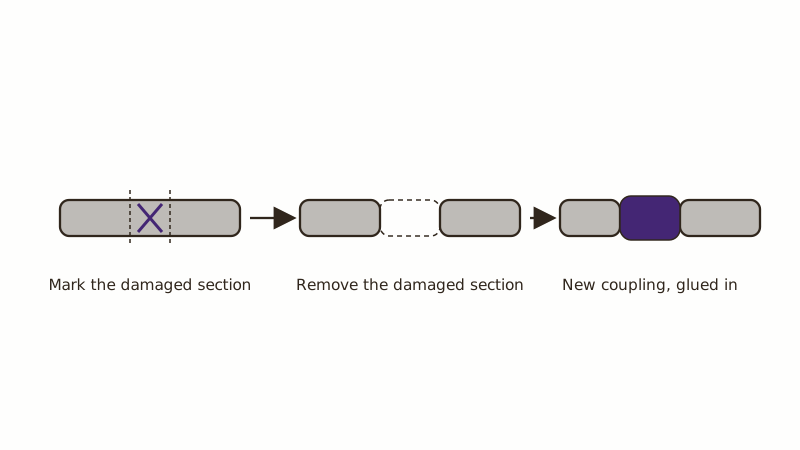
Cement goes on the pipe end first, then inside the hub, then the pipe end again, thin inside the hub to prevent puddling. Turn the pipe a quarter turn as you push it home, hold for 30 seconds, and wipe off excess. Do not use primer on ABS, which is a black plastic pipe often used for drains. Choose cement made for your pipe type, with gloves and safety glasses on throughout.
How long before you can turn the water back on?
Oatey says to allow 15 minutes for handling strength and two hours before pressure testing up to 180 psi, at temperatures above 60 degrees. Colder weather, larger pipe and damp air lengthen that, and in humid weather it recommends 50 percent more time. Check the label on your can.
A caution from the same sheet: the cure chart is for new piping and is not recommended for repairs or cut-ins on hot and cold water distribution systems, and Oatey tells users to contact its technical service for those times. So for a pressurized repair, longer is safer, and a plumber will know what to allow. Oatey also warns against using compressed air or gas to test PVC.
Is PVC used for hot water, and does it matter?
PVC is generally used for cold supply and drain, waste and vent lines, while hot water is commonly carried by CPVC or other materials. In Oatey's descriptions, CPVC is typical for hot and cold drinking water distribution, while PVC serves pressure and non-pressure piping. If a joint is on a hot line, identify the pipe before buying cement.
Pipe color and markings help. Printed text on the pipe lists the type and rating. Still unsure? A plumber can name the pipe on sight. Mixing cements and pipes is a common DIY error. A wrong match can make a repair that looks fine but fails under heat or pressure.
When is it time to let a plumber take over?
Phone a plumber if you cannot isolate a pressurized line, the leak hides in a wall or under a slab, the pipe is cracked in several spots, a main or sewer line is involved, or drywall and flooring are already soaked. A pipe that has actually burst is urgent: turn the main off before you do anything else.
Older homes may mix pipe materials, and newer tract homes often use plastic, so a repair can touch several types. Under the contractor board's rule a license is needed from $1,000 including parts, and for anything that needs a permit. The City of Ontario Building counter, (909) 395-2023, answers permit questions. Our page on burst water pipes covers urgent cases.
Common questions
Can I glue over a leaking PVC joint?
No. Fresh cement will not bond over a wet or already cemented joint and will not seal a leak. What does hold is cutting out the section and rejoining it with new pipe or a coupling, following the cement maker's directions.
Why does the joint leak only when I run water?
That points to a drain line, where leaks appear only when water flows through. It may be a cracked fitting, a joint that was not fully seated, or a slope problem that backs water up the joint. A plumber can run a pressure test on the line and rule out something bigger.
How long does PVC cement take to cure?
Oatey's sheet gives 15 minutes for handling strength and two hours before pressure testing, above 60 degrees and for small pipe. Cold, humid conditions and larger pipe add time, and its chart is not for repairs on hot or cold water supply. Follow the can and give extra time.
Is a small PVC leak worth fixing quickly?
Yes. Even a slow seep can soak framing and insulation, feed mold and waste water. Tackle it soon, and treat a temporary clamp as a short-term measure only until the proper fix is done. EPA's household-leak benchmark shows how much water a small leak can lose over a year.
Does insurance cover a leaking joint?
It depends on the policy, the cause and whether the leak was sudden. Many policies treat sudden bursts differently from slow seepage. Photograph the damage, stop the flow, and check with your insurer ahead of the repair. A written plumber's report on the cause is useful for any claim.