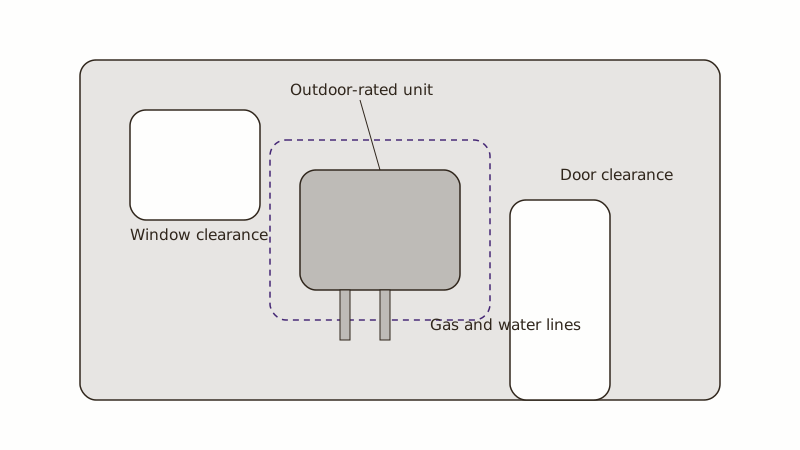
Only models rated for outdoor use can go outside, and the same model cannot then be moved indoors. In exchange, a gas unit mounted on an outside wall skips much of the venting an indoor install needs. In a mild climate like Ontario's, an exterior wall is a reasonable place when the garage is full or the closet is tight. This is one option inside the broader water heater repair and replacement picture.
The catch is exposure: weather, water freezing on a cold night, bumped hoses and a neighbor's window ten feet from the exhaust. Those are manageable if they are planned for.
Can any tankless heater be mounted outside?
No. A heater must carry an outdoor rating from its maker, because indoor models are not built to take rain, dust and temperature swings, and an outdoor model is not meant for indoor use. Check the model number against the maker's literature, and have the plumber confirm it on the estimate.
Gas and electric models both come in outdoor versions. The manufacturer's installation manual decides clearances to doors, windows and air intakes, so no general rule applies. An outdoor unit also needs protection against freezing, particularly electric models, and that protection depends on the model's built-in features. Still undecided on the type? Tank against tankless lays out the broader trade-offs.
What are the advantages of an outdoor install?
You gain floor space, and gas units avoid indoor flue pipe and the combustion air problems that come with it. Servicing is simpler, since a plumber works from the yard rather than a cramped closet. A leak or condensate drips outside rather than into drywall, which lowers damage risk if something fails.
That makes an exterior wall attractive in homes where the heater now sits in a hallway closet or inside a living space,, a setup you can find in postwar homes in Montclair and Chino. New homes in Ontario Ranch and The Preserve often have a side yard that already holds meters and utility connections. In master-planned communities, check HOA rules before drilling into stucco. The related guide on installing a tankless water heater covers the inside-the-house version.
What does an outdoor install need in the way of gas, water and power?
The burner's heavy draw dictates the gas pipe size, and the line gets a shutoff and a debris-catching trap upstream of the unit. On the water side, expect service valves, a relief valve rated for the unit with its outlet routed to a drain, and a pressure reducer when house pressure exceeds 80 psi. Electric models want a dedicated heavy circuit.
The Rheem guide adds that all installations follow local code, with the National Fuel Gas Code and the National Electrical Code applying where local code is silent. A gas smell means everyone moves away from the house before anyone dials SoCalGas, 1-800-427-2200. The law treats gas piping as regulated work, and a new gas line, step by step explains why, with the permit side in gas piping codes.
How do I protect an outdoor heater from freezing and scale?
Follow the manual's freeze-protection instructions, which may include built-in heaters, power that stays connected and insulation on exposed pipe. Freezing is uncommon but not impossible in the Inland Empire, and one cold snap can crack a heat exchanger. Isolation valves also let a plumber flush scale, which matters in this area's hard water.
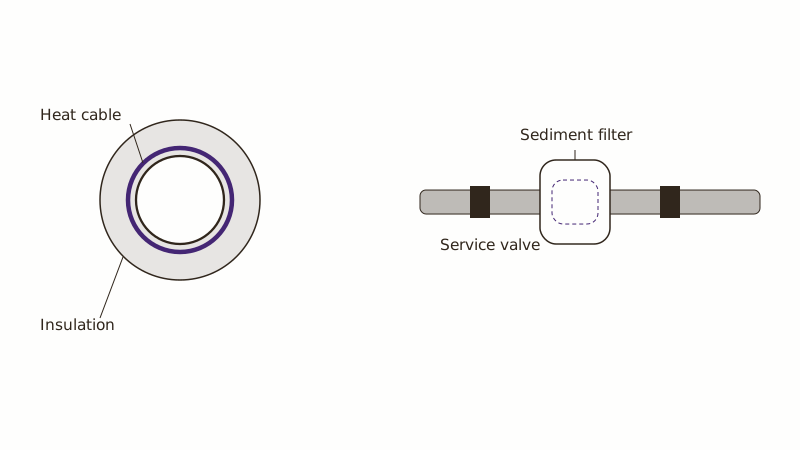
The City of Ontario's 2025 report lists hardness averaging 91 to 177 ppm depending on the source, and Chino's 2024 report shows its own wells up to 280, so expect scale. Cover exposed pipe with insulation rated for outdoor use, keep the unit clear of sprinkler overspray, and ask the plumber to point out the drain-down valves while you are present. A water softener upstream is one fix; see water softener installation.
What do permits and costs look like?
Adding or swapping a water heater runs through the building division. Ontario's Building office can be reached at (909) 395-2023 and Chino's at 909-334-3251. An inspector looks at gas, vent and mounting. For a yardstick, national tankless totals in Angi's July 2026 data begin near $1,400 and reach about $3,900, labor starting at $600.
Outdoor extras, meaning an exterior gas run, a weatherproof enclosure or a concrete pad, have no sourced price we could find, so none appears here, and they come on top of the national figures. Have each one itemized. How tankless totals add up breaks down the rest. Department of Energy guidance of more than 20 years of life for most tankless units helps justify the extras.
When is indoors the better choice?
Indoors wins when the wall facing the heater location is shared with a neighbor, when a bedroom window is nearby, when freezing is a real risk, or when an HOA forbids a visible unit. A garage install can be safer from weather and tampering. Either way, the unit's location should be chosen on site, not from a drawing.
If the heater is not the problem at all, check basics first: a tankless unit gone cold and repairing a tankless heater cover the usual failures. For someone to assess your wall or closet, send the quote form. Browse the home page for the other work we line up.
Common questions
Is it an all-day project?
Often one day for a straightforward gas install on an exterior wall that already has a gas stub, and longer if a new gas line, enclosure or electrical circuit is needed. Concrete pads and trenching add days. The estimate should state the expected time and when the permit inspection happens.
What belongs on an outdoor estimate?
List the model and its outdoor rating, the freeze protection, clearances from windows and the neighbor's wall, the gas pipe size and the permit. Separate lines make bids comparable. A contractor license in this state covers permit jobs and anything that reaches $1,000.
Should I take the day off?
Ideally, an adult is on hand when work begins, to confirm the chosen wall, and when it ends, to inspect the result. Unlock gates and clear the path to the wall. Expect interruptions to water and gas service for part of the day.