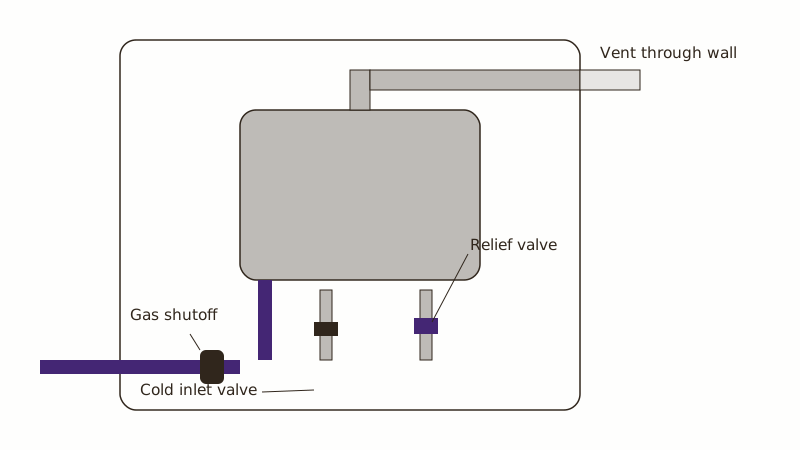
A tankless install has five parts: a gas supply large enough for the burner (or a heavy electrical circuit for an electric model), a vent path, a drain for acidic condensate when the heater condenses, service valves on the water lines, plus paperwork: a permit, then an inspection. The tankless heater is part of the wider water heater repair and replacement topic; this page covers the install itself.
Done well it takes a day or two. Done badly it produces cold-water sandwiches, error codes and venting that fails inspection. Nearly all the difference comes from planning the gas line and vent before the unit is bought.
Is my existing gas pipe big enough?
Often not. A tankless burner demands far more gas in a short burst than a tank does, and pipe sized for the old unit can fall short. Sizing follows the code and the manual, factoring in how far the heater sits from the meter, with a shutoff valve and a debris-catching sediment trap ahead of the unit.
SoCalGas is the gas utility across Ontario, Chino, Chino Hills and Montclair, and the gas piping work is a plumbing contractor's job under permit; this is not DIY territory. If gas is in the air, step out and call 1-800-427-2200, the SoCalGas emergency line. The Rheem guide adds that colder incoming water and higher elevation both call for more burner input to hit the same hot water output. Rules for the pipe itself are in gas piping code basics, and running a new gas line shows how that job is done.
How is a gas tankless vented, and what is a condensing unit?
Gas tankless heaters vent through a sealed pipe route to the outside, through a sidewall or the roof, with runs kept short and never reusing the old tank's flue. A condensing model squeezes more heat out of the exhaust, leaving it cooler and wetter, so it produces acidic condensate that has to drain through a trap.
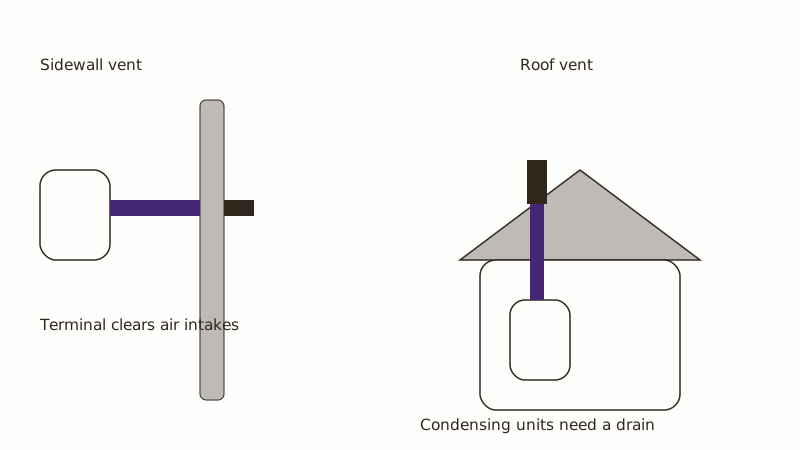
That is why a condensing install needs a drain nearby for the condensate and plastic vent pipe rather than metal flue. Vent terminations must clear air intakes and meet the minimum clearances in the manual. Concentric vents, a pipe inside a pipe, also need a condensate trap. The Rheem guide says to follow the model's manual for the exact clearances because they differ by unit. A house with a long run from the heater to an outside wall can limit where the unit goes.
What do the water connections and safety valves involve?
Service valves on both water lines allow the heat exchanger to be flushed later, and a pressure relief valve rated for the unit goes at the hot outlet with a discharge pipe to a drain. If household pressure exceeds 80 psi, a pressure-reducing valve belongs on the supply, and a mixing valve helps limit scald risk.
Scale is the long-term enemy in this region. The city's 2025 report lists Ontario hardness averaging 91 to 177 ppm, depending on the water source, and Chino's 2024 report shows city wells up to 280. Isolation valves make the yearly flush simple. If you run a recirculation loop, the guide notes it needs an expansion tank and check valves. A softener upstream can help, covered in water softener installation.
What are the code and permit steps?
A water heater swap generally goes through the city's building division, with an inspection at the end. Ontario's Building office answers at (909) 395-2023, Chino's at 909-334-3251. Where local code is silent, the Rheem guide points to the National Fuel Gas Code and the National Electrical Code. Earthquake strapping is a California requirement too.
Electric tankless models need a dedicated high-amperage circuit; the manual states the breaker and wire size, and panel work is for an electrician. The gas permit and inspection confirm the line, the vent and the shutoff. Nothing in current rules pushes you from gas to electric.
Price and duration: what to expect?
In Angi's national data from July 2026, $1,400 marks the low end of a tankless install and $3,900 as the high end, with labor starting at $600. Gas pipe upgrades and venting push the total up. A simple replacement fills a day. A conversion off a tank, needing gas pipe and vent work, may run into a second.
That is a national guide. Itemize the unit, gas work, vent kit, valves, permit, haul-away and condensate drain on any bid so offers compare fairly. More figures are in the tankless price breakdown, and if you are still deciding, read tank versus tankless. Longevity helps the math, since Department of Energy guidance puts most tankless life beyond 20 years.
Will a tankless unit fix a missing hot water or heating problem?
Not by itself. When taps run cold, a new tankless unit is one answer, but a failed element, pilot or thermocouple could be the real cause. Tankless heaters also serve taps only; they do not run a furnace or radiators, so a heating complaint needs its own diagnosis.
Check pilot lit but water cold and tankless units that quit heating before spending on new equipment. For an outdoor install, see outdoor tankless installation. For a site assessment by a plumber, send the quote form.
Common questions
Will the work spill into a second day?
One day is typical for replacing a tankless with another, two for a conversion. A tank-to-tankless change can add a gas line, a flue exiting the wall or roof and a drain for condensate, well beyond a simple exchange. Look for the duration on the estimate.
What should be itemized in the bid?
Gas pipe size and the math behind it, the vent path, where condensate goes, the exact brand and model, and the party responsible for the permit. Check the contractor license number too, since permit jobs, and jobs reaching $1,000, call for one in California.
Should I clear my schedule?
Ideally, yes, at opening and closing time. Water, and sometimes gas or power, is off while the unit is changed, and an adult should settle where the heater sits and review the final result. Clear space around the old heater and along the wall where the vent will exit.