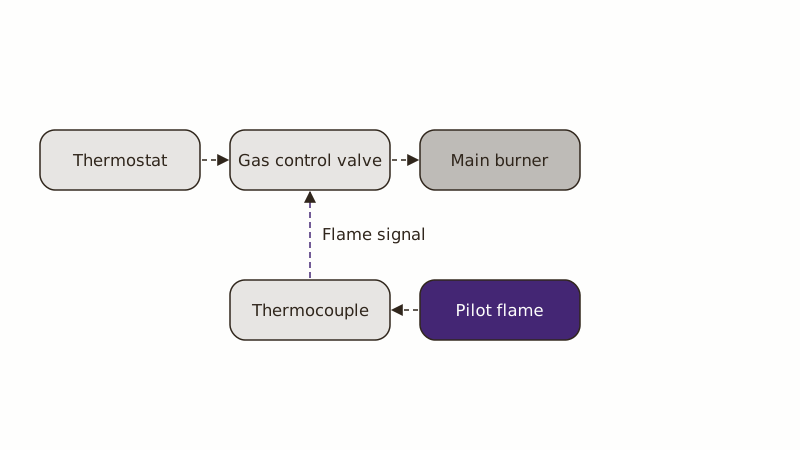
The pilot is only a small standing flame. The big burner underneath the tank fires when the gas control decides the water needs heat, and a handful of parts have to agree before it does. With the pilot lit and the shower cold, one of those parts is holding out. The first three checks cost nothing. It sits under water heater repair and stops where safe checks at home stop.
What is the first thing to look at?
Start with the dial. Has someone turned the thermostat down or set it to vacation? Is the gas valve at the base of the heater open? Is the breaker on, if the model has a control board? None of that costs a cent. With the dial right and the tank still cold after an hour or two, a safety device is probably blocking the burner.
Before touching anything, sniff near the heater. Gas in the air means out of the house, no switches, then SoCalGas from the sidewalk at 1-800-427-2200 (it serves Ontario), or 911 if the smell is strong or someone feels ill. Feeling dizzy or sick while the heater runs can signal carbon monoxide, so get outside and dial 911. Smell nothing and feel fine? Carry on. If the heater lit but the tap still runs cold, see no water coming out of the hot faucet.
Which safety devices can shut the burner off while the pilot stays on?
Several. The high-limit switch inside the gas control trips if the water overheats, and the supplier we read notes Rheem describes it as single use, so a trip usually means a new gas control. A thermal or flame-rollout switch trips when heat escapes the combustion chamber, often from a blocked vent. A flammable vapor lockout can trigger if solvents or gasoline sit nearby.
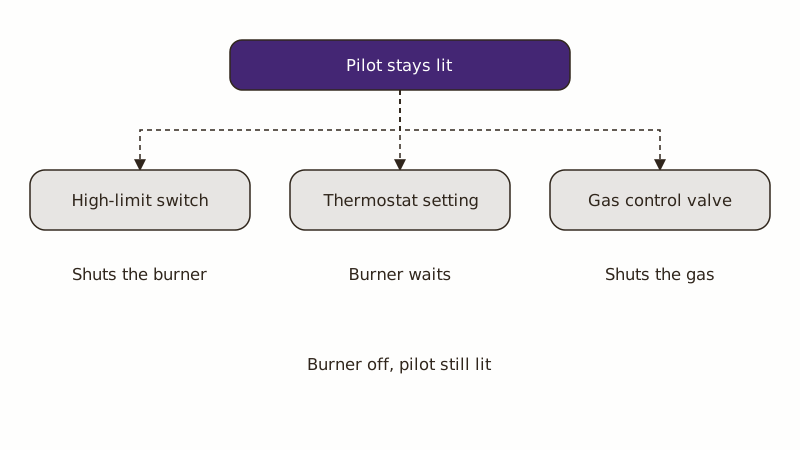
Keep paint, gasoline and cleaners well away from the heater, since vapors can set off the lockout. Repeated trips of a rollout switch point to an airflow or venting problem, and resetting the switch again and again hides the cause. None of these are homeowner repairs, because each one protects the house from fire or carbon monoxide. They are why this symptom ends in a plumber visit so often.
Could a failing sensor be the reason the burner will not fire?
Yes. The thermocouple or thermopile tells the gas control that the pilot is lit. If its signal is weak, the control will not open the main gas valve even though you can see the flame. A.O. Smith's guidance, as summarized by that supplier, lists a pilot that does not heat the thermopile enough, a defective thermopile or a loose wire.
On some new heaters, a status light blinks a code. For A.O. Smith and State heaters, the same source says two flashes mean low thermopile output, four mean the high-limit tripped, five a temperature sensor fault, seven a gas control failure and eight flame detected with the knob off. Bradford White uses different color-coded codes, so read your label. Our page on replacing a thermocouple covers the sensor side in more detail.
When does a failed gas control valve turn out to be the problem?
When the sensor is good, the thermostat is set right and nothing has tripped, the gas control valve itself may have failed inside. It combines the thermostat, the safety valve and the knob. The supplier we read says several status codes and a tripped high-limit call for replacing it. That is a larger repair, and on an older heater it may tip the decision toward a new unit.
Ask for a repair price and a replacement price side by side. An old tank, a past leak or a string of repairs can all favor replacement; read how often to replace a water heater and replacing a hot water heater. Our no hot water page covers electric models too.
Can I relight or reset the heater myself?
Relighting a pilot is acceptable if you smell no gas and follow the instructions on the heater label, including the wait time. Stop if it will not stay lit after a couple of tries or the flame is yellow. Leave covers on, safety switches alone and the gas control untouched. A plumber with the right contractor license does those.
State rules put anything at $1,000 or more, or needing a permit, in the hands of a contractor with a California license, so replacing a heater is plumber work. Ontario's Building office, (909) 395-2023, can confirm what a job needs. Scale builds in tanks too; the 2025 city report gives hardness averaging 91 to 177 ppm by source, which makes an occasional flush a fair question to ask.
Prefer to have it looked at? Ask for quotes, and expect the figure in writing first. More services are on the home page.
Common questions
Why does the pilot stay on but the water never warms?
The pilot only proves a flame is present. The main burner needs the gas control to open the valve, and it only does that when the sensor, the thermostat and every safety switch agree. Any one of them can hold the burner off, so a visible pilot says little about the cause.
Is it risky to leave it as it is?
A heater that is not firing is not a gas leak by itself, but a smell of gas always means act now. If you smell gas, or get headaches or nausea near the heater, leave and call SoCalGas or 911 as above. Otherwise put the control on pilot or off and book a plumber.
Is this the same as a pilot that keeps dying?
No. A pilot that dies usually blames the sensor or a draft. Here the flame holds but the burner never ignites, which points at the control, a safety switch or the thermostat. The dying-pilot case lives in pilot light repair.
Does any of this apply to an electric heater?
No, since electric models have no pilot flame at all, so a lit pilot is a gas-only idea. For electric units the checks differ: look at the breaker, the reset button on the thermostat, and the heating elements, all covered in no hot water from an electric heater.
What will a plumber likely find?
Usual verdicts: a worn thermocouple or thermopile, a tripped high-limit or rollout switch, a dead gas control, or a blocked vent. Testing goes cheapest first, and the plumber should explain the result and weigh repair against replacement. Get the numbers on paper before work starts.