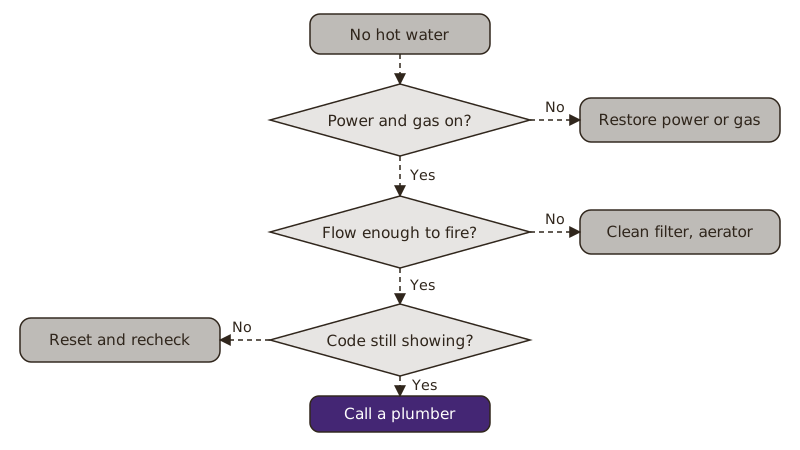
A tankless heater does not store hot water. It lights a burner or energizes elements only when it senses flow, so every "no hot water" call comes down to one of four things: no fuel or power, not enough flow to wake it, a blocked or scaled part, or a fault the unit has shut itself down for. This article works through those in order. It sits under water heater repair. Got a conventional tank instead? The sister problem for tanks is covered in a tank heater with no hot water. Want a plumber to look? Request a quote and describe the display.
What should you check before anything else?
Confirm the unit has power and fuel. Look at the display, check the breaker or outlet, and check that the gas shutoff handle lies parallel to its pipe, which is the open position. A propane unit needs fuel in the tank. A blocked vent can also stop a unit, so look for anything stuffed against the outlet.
Next, try other taps. If the hot side is cold everywhere, the heater is at fault. When only the shower runs weak, suspect that fixture's own aerator or cartridge. Most error codes clear with one reset, according to a third-party troubleshooting guide that summarizes the main brands. If the same ignition or flame code returns, stop resetting and call.
Could low flow be why the unit will not fire?
Yes, and it is a common one. Before the burner lights, a tankless unit has to see a minimum amount of water moving. The troubleshooting guide lists roughly 0.4 to 0.6 gallons a minute for Rinnai and about 0.4 to 0.5 for several other brands, and says a Rinnai shuts off below about 0.26. Those are third-party figures, so your manual is the final word.
A tap opened a crack, a clogged aerator, a low-flow showerhead or a half-open isolation valve can hold flow beneath the trigger point. Open the hot tap fully, then clean the aerator. If a unit fires at a full flow but not at a trickle, flow is the clue, and a plumber can test where it is being lost.
How do you clean the inlet filter?
The filter is a small screen where cold water enters the unit, and when it clogs, flow drops at every fixture. The troubleshooting guide, citing the Department of Energy, suggests cleaning it every 6 to 12 months. Close the cold inlet valve, cut power and gas to the unit, and open a hot faucet briefly so the line depressurizes.
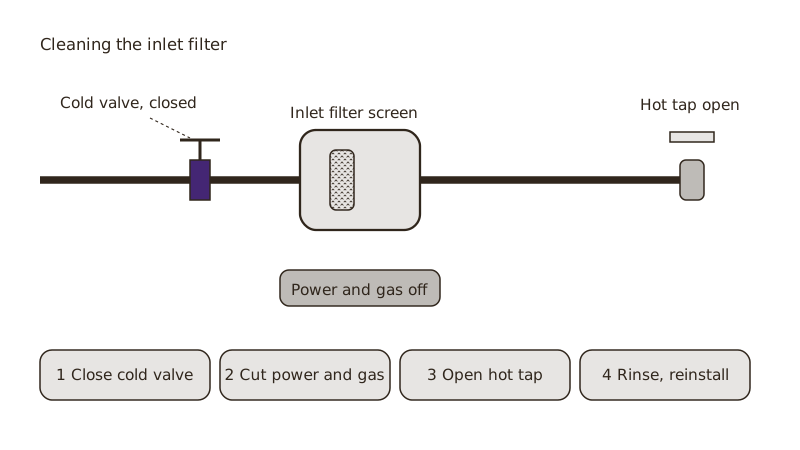
Unscrew the filter, rinse it, and brush off debris. Reinstall it, reopen the valve, check for drips and restore gas and power. Cannot tell which fitting holds the filter, or the isolation valves will not budge? That is a plumber's job. Forcing a corroded valve can cause a leak that needs more than a rinse to fix.
What do the codes on the display tell you?
Brands differ in how they number codes, so the manual for your model decides what one means. The guide lists, for example, 11 on Rinnai and E003 on Navien for no ignition, and 12 and E012 for lost flame. It also lists LC on Rinnai and E760 on Navien as scale or flush reminders, and treats overheating codes as serious.
Rinnai says code 14 should be taken seriously, so do not keep resetting an overheating code. A single reset after a power blip is reasonable. Repeated ignition, flame or overheating codes mean something is wrong with gas supply, venting, a sensor or the heat exchanger. Write the code down before you call, since it shortens the diagnosis.
Can hard water scale shut down a tankless heater?
It can reduce output, trigger a scale code, or cause overheating. Dissolved minerals gradually coat the inside of the heat exchanger. Navien asks for a descale at least yearly, sooner with hard water or heavy use. The same guide reports that Rinnai wants flushing at least annually and suggests a professional do it.
Local hardness varies. The city of Ontario's 2025 report gives averages from 91 to 177 ppm depending on source. Dividing by 17.1 ppm per grain, that is roughly 5 to 10 grains per gallon, our own arithmetic. Monte Vista Water District's 2025 report gives 135 ppm average with a range up to 340, and the City of Chino's 2024 report lists up to 280 for its own wells. Your address determines your blend.
Is it safe to flush the unit yourself?
The process is well documented: isolate the unit, circulate white vinegar or an approved descaler through it for about 45 minutes, rinse and clean the filter. Rinnai specifies undiluted white vinegar and advises against chemical cleaners, and it recommends a professional for flushing, per the guide. Navien warns that skipping maintenance may affect its warranty.
Because the job involves shutting off gas and power and working with isolation valves, many owners hire it out. Ask a plumber whether a flush kit is already installed, and what the maintenance plan should be for your water. Annual service is a better habit than a rescue flush after the unit fails.
Where does DIY stop on a tankless heater?
Stop on a gas smell, a repeating error code, water inside the cabinet, scorching or sputtering output, or any work on gas lines, venting or condensate. The guide lists these as jobs for a technician, and I would add anything you are unsure about.
Smell gas? Everyone leaves, and from outside you ring the SoCalGas leak line, 1-800-427-2200. Danger calls for 911. If anyone has a headache, dizziness or nausea while the heater runs, get to fresh air and call 911, since those can be signs of carbon monoxide. Urgent problems go through emergency water heater repair.
Tankless or tank: is it time to change?
If a tankless unit has repeated faults, ask whether the cause is water, venting or the unit itself. A tank can be simpler, and a tankless unit offers endless flow when it works. The decision depends on gas line size, venting, hardness and your habits.
Pros and cons sit in tank versus tankless, and tankless repair cost puts numbers on the repair side. Only a quote in writing from the local plumber who sees the unit sets the real price. Make sure it lists what is included, whether a flush, a new filter or a part.
Common questions
Why does my tankless heater cycle hot and cold?
Flow can drop below the minimum when a tap is partly closed or another fixture draws water. Scale and a clogged filter can also cause swings. Try one fixture at full flow, clean the aerator and the inlet filter, and read any code. If it persists, have a plumber check.
What does a scale code mean?
It is a reminder that mineral buildup needs a flush. Rinnai shows LC and Navien shows E760, according to a third-party guide. Do not ignore it, because scale can lead to overheating. Flush it by the maker's method or hire it out, and write the date down.
Do tankless heaters need a plumber to maintain them?
The maker's instructions govern. Flushing is a common annual task, and Rinnai recommends a professional for it, per the guide. Gas, venting and condensate work need a technician. If you handle the filter yourself, shut off power, gas and water first, and relieve pressure before opening anything.
Can a power cut cause no hot water?
Yes. Gas models still rely on electricity for controls and the fan, so an outage stops them. When power returns, the unit may need a reset. If it does not restart after one reset, check gas and vent before calling a plumber.
Should an older tankless unit be repaired?
It can be, because many failures are filters, scale or a sensor. A cracked heat exchanger or repeated overheating changes the math. Ask for the cost of repairing and the cost of replacing, and ask what upkeep it has had, because a neglected unit tends to repeat the fault.