Two 2026 price guides we read agree on the shape: small parts and flushes cost little, and a failed heat exchanger costs a lot. Plazma Homes gives $150 to $1,300 overall with about $600 typical, and Onotto gives $150 to $600 for common parts. They disagree at the top because they define "repair" differently. This page sorts the numbers by job, for water heater repair customers in Ontario. Only a quote written after a visit fixes your actual price.
What is the usual bill when a tankless unit needs fixing?
Plazma Homes puts the full span at $150 to $1,300, with around $600 as the usual bill for common fixes. Gas units run $150 to $650 and electric units $100 to $600 in the same article. Onotto's range for a worn sensor, igniter or fan is $150 to $600. Plazma's labor rate runs $45 up to $150 per hour, and it says high-cost states like California land higher.
Plazma says an easy repair eats one to three hours, which makes the bill part parts, part time. A trip or diagnostic fee may be billed separately. Plazma doesn't state one, so ask any plumber what theirs is and whether it's credited if you go ahead.
Treat every figure in this page as orientation. They come from national articles, not from Ontario invoices.
How much do individual repairs run?
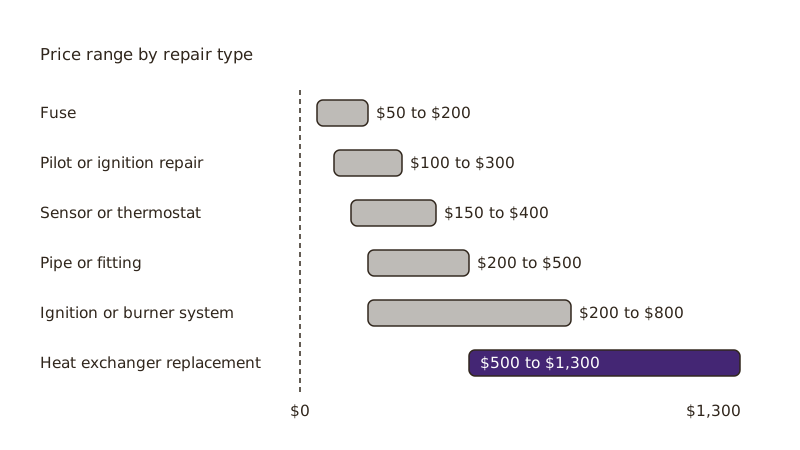
By repair type, Plazma lists: a fuse at $50 to $200, pilot or ignition repair at $100 to $300, a sensor or thermostat at $150 to $400, a pipe or fitting at $200 to $500, the ignition or burner system at $200 to $800, and a heat exchanger replacement at $500 to $1,300.
Onotto adds one: a failed control board on a unit around 13 to 15 years old costs roughly $400 to $800, which it frames as a judgment call against a $2,500 to $4,500 replacement. A leaking heat exchanger is its clearest case for replacing the unit, since fixing it would cost almost as much as buying new.
The spread inside each line comes from the part, the brand and how awkward the unit is to get at. Wall-hung units in tight closets take longer than those on an open wall. Parts that must be ordered in can add days.
What does descaling cost, and is it worth it?
Professional descaling runs $150 to $350 in Plazma, and Onotto says $150 to $250 from a plumber versus $40 to $150 for a DIY kit. Plazma puts annual maintenance as a whole at $75 to $350. Since scale causes many error codes, flushing is the cheapest fix to try before any part gets replaced.
Local water makes this relevant. Hardness in Ontario's 2025 water report averages 91 to 177 ppm, with the number moving by supply source. Onotto's rule of thumb is a flush every six months above roughly 10 grains of hardness, and yearly otherwise. Dividing ppm by 17.1, which is our own arithmetic, puts Ontario at about 5 to 10 grains.
Plazma adds that hard-water homes may need a flush twice a year. The cost of regular descaling is small beside a heat exchanger, so for most Ontario homes it's worth doing. Our page on tankless service and repair describes what a visit includes.
When does replacing beat repairing?
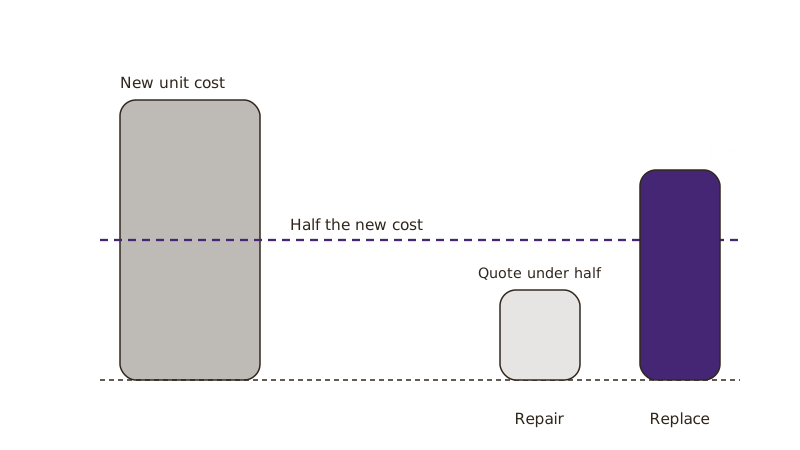
Plazma gives one yardstick: a repair near the 50 percent mark of a new unit's cost tips the balance toward replacing. Age and history count too. A unit near or past its 15 to 20 year lifespan, or one that has needed several repairs in two years, leans toward replacing.
For a new installed unit Plazma shows $1,400 through $5,600, and Onotto narrows that to $2,500 through $4,500. The gap reflects different assumptions about venting, gas line size and labor. Our page on tankless installation cost goes into what swings that number.
A younger unit under warranty with a minor fault is the opposite case: repair, and check whether the warranty covers parts. Plazma notes this, and your manual will say what coverage requires, including descaling.
Weighing a different type altogether? A tank-or-tankless comparison lays out both, and water heater replacement cost prices the swap.
How do you keep from paying for the wrong fix?
Before a part gets ordered, have the diagnosis put in writing and ask if a descaling flush came first. Take a photo of whatever code the screen shows. A plumber who reads the code and the fault history can be specific about the cause instead of replacing parts by trial.
Check the symptoms against the cheap causes. A blocked inlet screen, low flow at a fixture and the normal cold-water sandwich between uses all look like faults and cost little or nothing to fix. When nothing hot comes out at all, the guide to tankless units giving no hot water works through the checks.
Gas deserves caution. Connections and gas piping are for a qualified contractor. At the first whiff of a leak, evacuate, then ring the utility's leak line (SoCalGas, 1-800-427-2200) from outdoors. More of our services are on the Chaffey Pipe and Drain home page.
Common questions
How much of my day will it take?
Plazma's figure for simple jobs is one to three hours, with a flush on top. A job that needs a special-order part may take more than one visit. Mention the brand, model and error code when booking, so likely parts ride along.
Which questions matter when comparing repair quotes?
Ask what the trip charge is and if it comes off the bill, how parts and labor are split, whether they work on your brand, and what warranty backs the repair. Have the quote in writing, with their reasoning for repair over replacement at your unit's age.
Can I go out while it's being done?
Yes, for arrival and wrap-up. Someone approves the quote, shows the unit and sees it fire up at the end. Expect water, and sometimes gas or power, to be interrupted, so plan your showers and laundry around it. You don't need to watch the whole job; being reachable matters more.
Should I expect a trip fee?
Many plumbers bill a trip or diagnostic fee and subtract it if you proceed. Plazma lists none, so don't assume either way. Ask for the amount and the credit policy at booking, and make sure both appear on the quote.
Will a repair void my warranty?
It can, if the work is done by someone the maker doesn't accept or if required maintenance, such as annual descaling, was skipped. Check your manual or the maker's warranty page before authorizing work, and have what was done written down. Hold on to the paperwork.