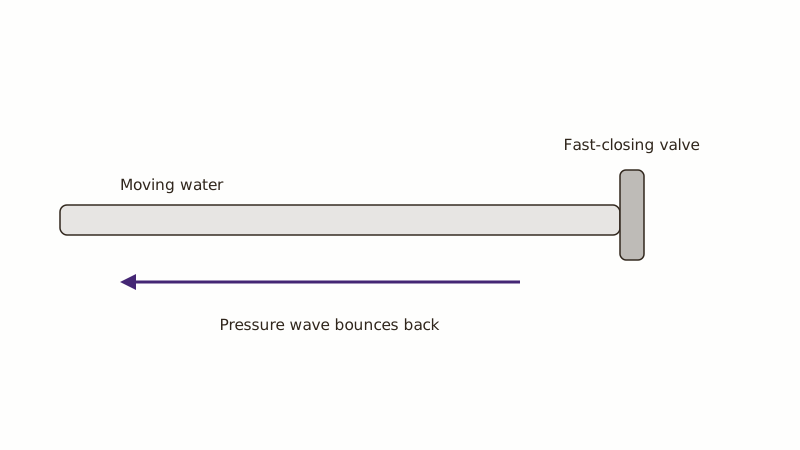
Water hammer is the knock, thud or shiver in the walls just after something cuts off the flow: a washing machine valve snapping shut, a kitchen faucet turned off quickly, a toilet finishing its fill. Flowing water carries momentum, and when it halts abruptly that energy goes into the pipe walls. The problem is common, usually curable, and worth curing, since repeated shocks can work fittings loose. The home page lists the plumbing help we arrange; below is how to trace this noise.
What makes water hammer noise in a house?
A fast-closing valve halts the moving column of water, and a pressure wave bounces back down the pipe; that wave is the banging or shuddering. Dishwashers, washing machines and some toilet fill valves close quickly, so they are frequent sources. High water pressure, loose pipes and a missing air cushion make the noise worse.
Wikipedia's explanation of water hammer lists the same household causes: a sudden stop from an appliance or a fast-closing valve, a check valve slamming shut, and long straight pipes with high flow velocity. A pipe that is not strapped can slap against a stud, which adds rattle. Pay attention to when it happens: after the washer fills, after the kitchen faucet shuts, or when a toilet refills, since that points to the fixture involved.
Is plain high pressure behind it?
Quite possibly. High static pressure pushes water faster, so each stop hits harder. California Plumbing Code section 608.2 sets 80 psi as the cap, and a regulator brings a house down to it. A gauge threaded onto an outdoor hose bib reads your number; anything above 80 deserves a regulator quote.
Wikipedia lists a pressure regulator among the ways to reduce water hammer, along with slow-closing valves and non-slam check valves. If the house has a regulator already, it may be failing and letting pressure creep up. Locating it is covered in where a water pressure regulator is located and adjusting a pressure regulator valve, and have a pro check any adjustment you are unsure about.
At what point is a plumber needed?
When the banging is loud, began suddenly, arrives with a pressure change, or survives the cheap fixes. A plumber can test pressure, inspect the regulator and straps, and add arrestors. A noise coming from inside a wall you cannot open is reason enough on its own.
Ask who will do the work and what the plan is, and look the contractor's license up on the state's site. Anything priced at $1,000 or more in parts and labor, or needing a permit, falls under the state's license rule. A good service explains the cause and gives a price in writing. Read customer reviews with care, and ask for a clear description of the repair. Routine maintenance such as checking a regulator every few years helps.
What is different about older and newer homes in Ontario?
Older homes near downtown Ontario and the Euclid Avenue area may have older pipe, loose straps or lost air chambers, while larger newer communities such as Ontario Ranch use newer materials, though even those can bang if a fixture closes fast or pressure runs high. The location of the noise matters more than the era of the house.
Which supplier delivers your water, and at what pressure, depends on the street and the service area, so a gauge reading is more useful than a guess. If the noise only began after a new appliance or a repair, start with that. For the broader picture of local plumbing help, see our service areas page. If you want a plumber to see it, ask for quotes and the price is put in writing first.
Is water hammer harmful, and is the sound a sign of a leak?
The noise does not mean there is a leak, but it does strain the system. Spike after spike can loosen fittings, stress joints and wear out appliance valves. A single bang now and then is minor. Loud, frequent banging deserves attention before it turns into a leak at a joint, especially in older pipe.
Banging plus damp walls, stains or a rising bill means checking for a leak. EPA's average-household leak figure is more than 9,300 gallons a year, and a strained fitting can start one. The meter check is explained in a high water bill with no visible leak. A ticking or humming gas pipe is a separate matter: smell gas and you go outside and phone SoCalGas on 1-800-427-2200.
What cures the banging at the kitchen sink or in the bath?
Begin with the cheap options. Identify the fixture that triggers it, check that exposed pipes are held by straps or clamps, and open any partly closed valves under the sink, since a throttled valve speeds the water up. An old toilet fill valve can give way to a quiet-fill model. For stubborn noise, a water hammer arrestor on that fixture's supply soaks up the shock.
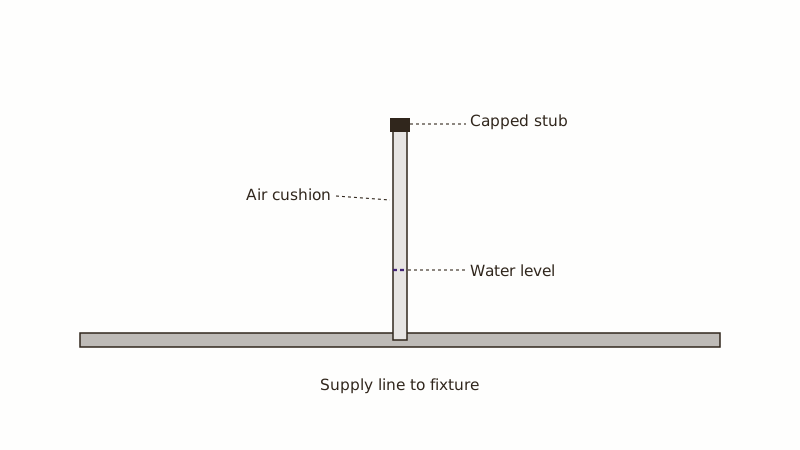
Many houses were built with air chambers, short capped stubs of pipe behind a fixture that cushion the shock. They gradually fill with water and quit. A common remedy is draining the system: close the main, open the top and bottom faucets, wait until it empties, shut the faucets, and reopen the main slowly to let air back in. If that fails, a plumber can fit arrestors at the sink, washer and dishwasher.
Common questions
Does water hammer go away by itself?
Rarely. If the cause is a failed air chamber, loose straps or high pressure, the noise continues and may get worse. Draining the system or adding an arrestor often fixes it for good. If the noise is new, it can follow a repair that disturbed a pipe or a change in pressure, so retrace what happened that week.
Can a dishwasher or washing machine cause it?
Yes, both use quick-closing valves that stop the flow within a second, so they are among the most common triggers. If the bang follows one of them, an arrestor on that appliance's supply is a cheap and targeted fix. Make sure the hoses and the shutoff valves are secure.
Why does my toilet bang when it finishes filling?
The fill valve closes sharply at the end of the fill. Replacing it with a quiet-fill valve, or throttling the shutoff valve slightly, usually helps. If other fixtures bang too, the cause is probably pressure or loose pipes, not the toilet. Details in repairing a toilet fill valve.
How can I check the water pressure myself?
Thread a pressure gauge onto an outdoor hose bib or laundry tap, open it, and read the dial with every other tap off. Hardware stores sell gauges. A reading above the 80 psi code ceiling is a cue to ask a plumber about a regulator. Leave a regulator you do not understand alone.
Is it a problem in the kitchen only?
If the noise only comes from the kitchen, check the faucet, the dishwasher supply and the sink strapping first. A single-lever kitchen faucet shuts the flow quickly, so it can hammer. A different bang in only one spot often means a loose pipe nearby or a worn washer in that fixture, not a house-wide issue.