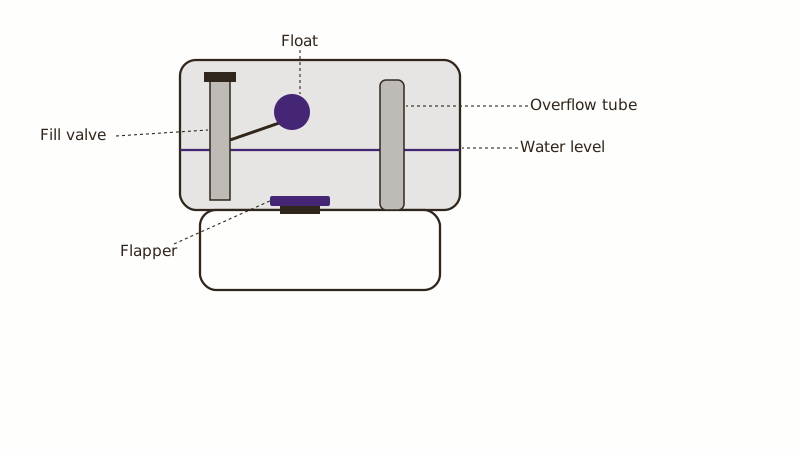
Before buying parts, pop the lid off the tank and watch. Water sliding quietly down the bowl means the rubber stopper at the tank's floor is letting go. Water climbing the tall tube and spilling over blames the fill valve or the float controlling it. Most calls come down to those two. Here is how to separate them, fix each one, and judge when toilet repair or replacement is the sounder route.
What keeps a toilet cycling long after the flush is over?
Tank water is draining away when it should not, or the refill valve never closes. A leaking stopper lets water dribble out to the bowl, while the fill valve works nonstop to make up the loss. If the fill valve sticks or the float rides too high, water goes straight down the overflow pipe. The loop has no end until one part is fixed.
Use the table to pair what you notice with a likely cause.
| Observation | Probable culprit |
|---|---|
| Faint trickle down the bowl, refill burst every few minutes | Rubber stopper (flapper) not seating |
| Water rushing down the tall standpipe, steady hiss | Fill valve not closing, or float set high |
| The handle needs jiggling or holding | Chain too tight, snagged or tangled |
| Refill noise but nothing visible leaking | Worn fill valve seal or grit in it |
| Toilet refills with nobody nearby | Slow stopper leak, sometimes called a ghost flush |
Per the EPA, an aged stopper can trigger flushes on its own or leak silently, and total leakage in an average household passes 9,300 gallons annually.
Is there a quick test to prove which part is failing?
Yes, and it costs nothing. Stir several drops of dye into the tank, skip the flush and give it about ten minutes. Should the bowl water pick up the color, the flapper leaks; the EPA recommends exactly this method. A clear bowl with the noise still going points to the fill valve, float or standpipe.
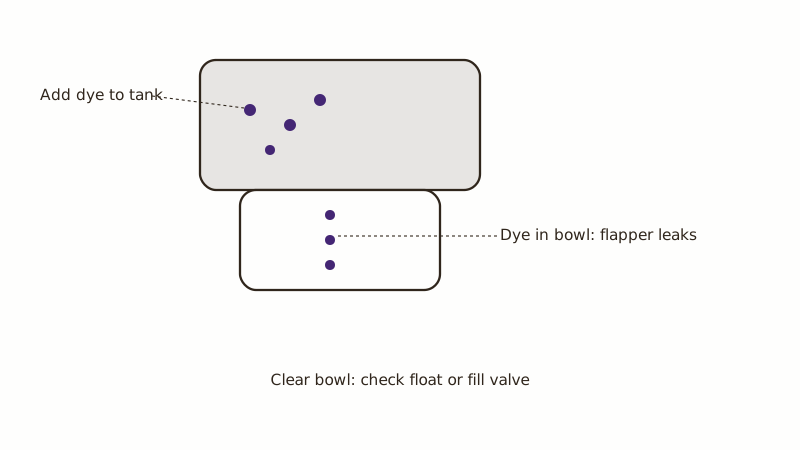
Rinse the dye away with a flush afterward so nothing stains. Then study the water line, which should sit a little below the tip of the standpipe. Water touching the rim is spilling into it, so the float or fill valve needs adjusting.
To silence the toilet while you work, find the angle stop (a small oval or round knob on the pipe behind the bowl, near the floor) and twist it clockwise to the end of its travel.
What do I do, in order, to make it stop?
Go from cheapest to costliest. Wiggle the handle. Inspect the chain, which wants a little slack, and free it if it has hooked under the stopper. Wipe the seat the stopper lands on to clear grit. Still running? Replace the stopper, then adjust the float, then swap the fill valve.
Chain length is the sneaky one. Pulled taut, the chain holds the stopper slightly open; too slack, it will not lift fully. Mineral grit on the ring where the stopper lands can hold it open as well, and a rag wipe sometimes ends the problem.
A fresh stopper is the usual next step. Take the old stopper to a hardware store counter so the shape matches your toilet, since several designs exist. EPA advice is a new one at least every five years, sooner if it feels slick or brittle. The install is described on the flapper repair page.
For a high water line, shift the float: squeeze the clip on a cup float and slide it down, or bend the arm or turn the screw on a ball float. A fill valve that refuses to shut gets its own walkthrough in the fill valve repair guide, and a cracked or loose standpipe is covered under overflow tube repair.
Why can't you use liquid Plumr in the toilet?
Liquid-Plumr says its own products are not designed to remove the waste that may be clogging a toilet. Its FAQ also warns against mixing the product with ammonia, toilet bowl cleaners or other clog removers, because doing so could splash or release hazardous gases. It is a sink drain product, not a bowl one.
None of that helps a running toilet. A chemical opener does nothing for a stopper, float or fill valve, and it puts a caustic liquid into a bowl where you may soon be working with your hands. The brand also advises against plunging while its product sits in a drain, because it can splash back.
If the toilet is both clogged and running, use a plunger first and read about clearing a blocked toilet.
Is a running toilet inflating my water bill?
Quite possibly. EPA estimates put household leaks near 180 gallons weekly, with toilets a common source and worn flappers the usual reason. A trickle that runs all day is a classic explanation when the bill climbs and no pipe is visibly leaking.
Run the dye test on every toilet, not just the noisy one. If numbers still look wrong, why water bills climb and high bills with no visible leak help you rule out other causes.
Local water plays a part. Ontario's 2025 report shows hardness averaging 91 to 177 ppm depending on source, and mineral crust can form on a stopper seat or inside a fill valve, keeping it from closing. A toilet that keeps failing every year or so makes scale the suspect.
How far should a home repair go before calling for help?
Call someone if fresh parts change nothing, the angle stop is frozen, water leaks from the base or supply line, the tank is cracked, or you would rather not lift the tank. Overflow is another trigger: a toilet that floods needs the water shut off right away and then professional help.
When a toilet is old and has needed repeated parts, a new one can cost less over time; see what a replacement costs here. Chaffey Pipe and Drain arranges visits through its quote page, and the plumber travels to your address.
Common questions
Why does it refill when nobody touched it?
A ghost flush: the stopper seeps slowly, the tank drops, the fill valve kicks in and you hear water for no reason. Dye in the tank confirms it. A new stopper, and sometimes a wiped seat, tends to end it. Repeats within months point to scale or a warped seat.
How much time does the repair need?
A chain or float tweak takes minutes. A first-time fill valve swap often runs thirty minutes to an hour. Rusty fittings, a split tank or a seized angle stop stretch it, and any of them justifies a professional. Ask for a time window and a written price first.
Can I just wait until the weekend?
You can, though water and money disappear meanwhile. By EPA numbers, a single worn stopper may waste thousands of gallons yearly without a sound. If the repair must wait, close the angle stop and reopen it only for flushing. That keeps the damage small until the part arrives.
Which parts should I buy?
Most often a stopper or a fill valve, occasionally a chain or float. Take the old stopper along or write down the toilet's brand and model, since sizes differ. Universal fill valves fit many toilets, but some tanks need a specific stopper.
Could it damage the floor or fixtures?
Running water alone does not, but it hides leaks that can. A wet base, a dripping supply line or a seeping tank can rot a subfloor and swell cabinets. Run a hand around the foot of the toilet for dampness whenever you work on it.