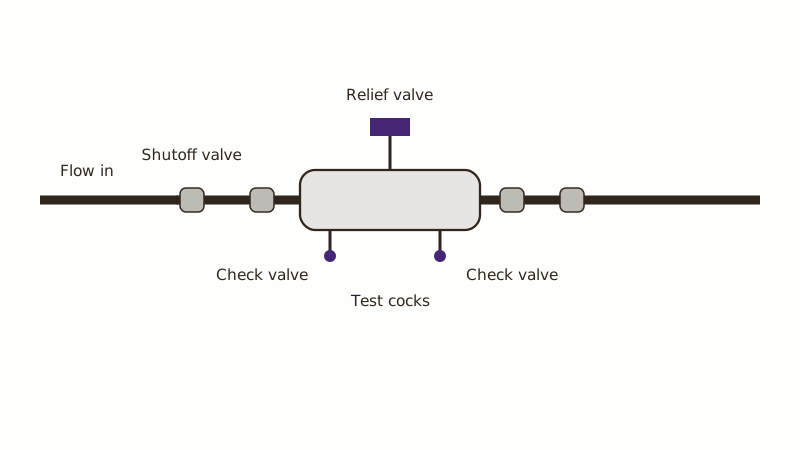
You do not test a backflow assembly yourself. Calibrated gauges and a trained hand are needed, and in Ontario the utility accepts reports only from testers approved by San Bernardino County, according to a testing company's summary of the local rules. Your job is smaller: know where the device is, keep it reachable, book the tester on time, and make sure the report reaches the utility. This page is the practical side of permits, codes and inspections, plus a short section on getting a plumbing permit.
What is the tester actually doing out there?
The assembly has small ports built to take a calibrated gauge kit. Working through a set sequence of valve positions, the tester reads pressures to learn whether each check valve seals and the relief port discharges as designed. Water drops out briefly. Pass: reverse flow is blocked. Fail: repair or replacement, then another test.
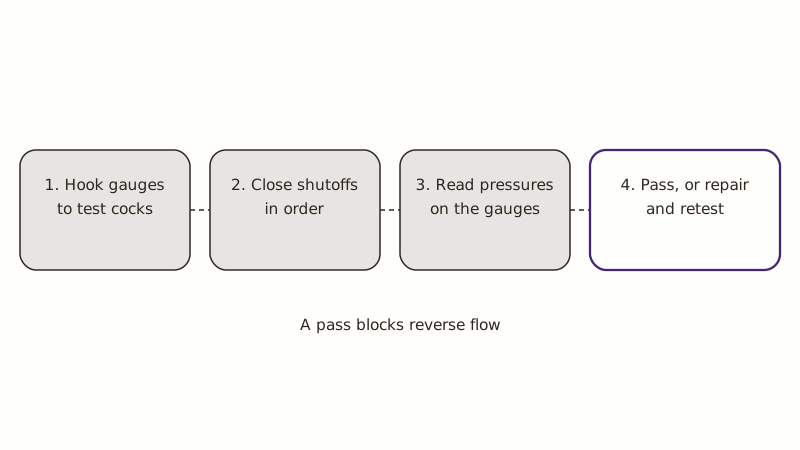
Expect the visit to be short for a single device. Afterward the tester writes up the results on a form for the utility. If the device fails, nothing is "wrong with your water": the assembly itself needs a part, a rubber seat, spring or a full swap. The repair has to be followed by another test. Details on what the device does are on backflow prevention testing.
What should be ready before the tester arrives?
Give the tester elbow room: clear stored items, trim plants, unlock any cage, and confirm the device is not buried or sitting in a puddle. Locate the main shutoff, warn the household that water will drop out for a moment, and dig out last year's report if one exists.
Look for the notice, too. Utilities send owners a reminder when a test comes due, and per that same tester's summary Ontario wants a yearly test plus a retest following new installation, repair or a move of the device. Confirm the current rule and the approved tester list with the Ontario Municipal Utilities Company at (909) 395-2600, 1425 S. Bon View Avenue. Keep every report: owners are expected to hold their own records.
Which testers count, and who covers the bill?
Only a tester approved by the county can perform the test and file the report in Ontario, per the same summary. Plumbers who also hold that approval can do it. The property owner pays for installing, maintaining and testing the device, according to that summary. Always confirm the status of any tester with the utility before booking.
If a repair or new assembly is needed, ordinary contracting rules apply, and the state's contractor board draws its licensing line at a $1,000 job or any permitted one. The tester proves the device works, and a contractor fixes it. For gas and other permit work, see the hub page linked at the top, and for large properties the page on commercial backflow testing.
Where does a plumbing permit come from here?
The source is Ontario's Building office, City Hall, 303 East B Street, (909) 395-2023. Ask what your project needs, file the application with whatever plans the office wants, pay the fee, then arrange inspection visits as work progresses. Most people leave that to the contractor.
The counter has set quiet hours: the Building counter closes for staff meetings Tuesdays 7:30 to 9:00 am and the first Thursday of each month 8:00 to 10:00 am, so plan around them. Ask Building what plans a modest job requires, because a straight fixture swap is nothing like running new gas pipe or relocating a drain. Do not guess at plan requirements; the office will say. A phone call often saves a trip.
What does the permit application need?
Typical entries: the site address, who owns it, the contractor, a description of the job and, on bigger projects, a drawing. A plan for a plumbing change normally shows fixture locations, pipe sizes and routes. The Building office decides what level of drawing it wants, so confirm the exact requirement with them before you draw anything.
A hired contractor completes the form, pulls the permit and meets the inspector. Doing your own work, where the city permits it, puts paperwork and inspections on you. Never begin permit work and sort it out later; ask the city first, since unpermitted jobs can snag a future sale.
After a failed test, ask for quotes to line up a repair; the figure is written down first. Other jobs are on the home page.
Common questions
What is the testing schedule?
A tester company's summary of the local program says once a year, with another test following installation, a move or a repair, and sometimes more often after repeat failures, which it says the city can require. Rules shift, so verify the current schedule with the Ontario Municipal Utilities Company, (909) 395-2600.
Does an ordinary house have a device at all?
Many do not need one at the meter. They turn up on irrigation, fire sprinkler, pool fill and commercial lines, or wherever the utility spots a cross-connection risk. A testing notice in the mail means you have one. Unsure? Call the utility to see if the address is listed.
What follows a failed result?
A fail means it did not hold pressure or the relief valve did not open properly. Typically a repair kit or swap follows, then a retest. A failure is not something to park: the utility wants a passing report, and a leaky device can let dirty water back into the supply.
Can a regular plumber do the test?
Only if that plumber also holds the county approval to test and report. Many plumbers do not. Ask for the tester's approval before booking, and confirm with the utility if the list is not obvious. The plumber who repairs the device may be a different person from the tester.
Should somebody be home that day?
Not always, though the device must be reachable and the water able to be shut off briefly. A locked yard needs a plan for access. If you are away, ask the tester whether the visit can go ahead without you, and confirm the report will still be filed.